Category: Trading Tutorials

  • What Is Leverage? A Practical Guide to Using Leverage in Forex and Crypto

    What Is Leverage? A Practical Guide to Using Leverage in Forex and Crypto

    Leverage is one of the first concepts that stops traders in their tracks. What is leverage, exactly? The core idea is straightforward: leverage lets you control a larger position in the market than your own capital alone would allow. A trader with $1,000 in their account can open a position worth $30,000 or even $100,000, depending on the leverage ratio their broker provides.

    That amplification cuts both ways. The same mechanism that turns a small price move into a meaningful gain can wipe out your balance just as quickly if the market goes against you. Understanding what is leverage — not just the definition, but how it behaves under real conditions — matters more than most traders realise before they experience it firsthand.

    This guide from our prop firm covers how leverage works in forex and crypto, what the real-world numbers look like, and how to use it without letting it use you.

    What Is Leverage?

    At its core, leverage is borrowed exposure. When a broker offers you leverage, they allow you to open a position that is larger than the funds you have deposited. The deposit you put up to open and maintain that position is called margin — leverage and margin are two sides of the same coin.

    The ratio describes the relationship. A leverage ratio of 1:100 means that for every $1 of your own capital, you control $100 in the market. A 1:30 ratio means your $1 controls $30 worth of exposure.

    Leverage does not change the direction of the market, and it does not improve your win rate. What it does is magnify the financial consequence of each pip or percentage-point move. A 1% adverse move on a 1:100 leveraged position erases your margin entirely. The same move on a 1:10 position costs you 10% of it. The mechanism is identical; the scale is what changes.

    How Leverage Works in Forex

    Forex is the market where leverage ratios tend to be highest. Retail brokers in most regulated jurisdictions cap leverage at 1:30 for major currency pairs — this is the limit set by ESMA for European brokers and mirrored by the FCA in the UK. Brokers operating under lighter regulatory frameworks and prop firms may offer 1:100, 1:200, or higher depending on their structure.

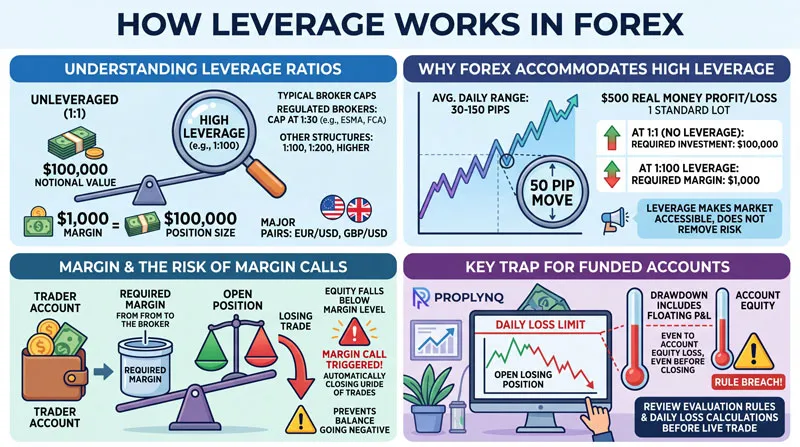
    The reason forex accommodates relatively high leverage is the nature of price movement. Major pairs like EUR/USD or GBP/USD typically move in a range of 30 to 150 pips on an average day. At 1:1 — no leverage — a 50-pip move on a standard lot represents $500 in real money. At 1:100, that same 50-pip move still represents $500 per lot, but your margin requirement is $1,000 rather than $100,000. The leverage makes the market accessible; it does not make the underlying risk disappear.
    How Leverage Works in Forex

    Margin is the collateral your broker holds to keep the trade open. If your account equity falls below the required margin level — caused by a losing open position — the platform may trigger a margin call and close your trades automatically to prevent your balance going negative.

    One point that catches many traders off-guard: in most funded account environments, drawdown calculations include your floating P&L, not just closed trades. An open losing position counts against your limit even before it is closed. This is particularly important when using higher leverage, since an open leveraged position can move your equity significantly within a single session. Reviewing the PropLynq evaluation rules before your first live trade — and specifically how the daily loss limit is calculated — removes the most common source of avoidable rule breaches.

    How Leverage Works in Crypto

    Leverage in crypto operates on the same mechanical principle as forex, but the context is considerably different. Crypto assets can move 5%, 10%, or even 20% in a single session. That volatility fundamentally changes what a safe leverage level looks like in practice.

    On centralised exchanges that offer leveraged crypto trading, ratios can range from 2x to 125x depending on the asset and the platform. Perpetual futures are the most common vehicle for leveraged crypto exposure. When you open a leveraged long position on Bitcoin, you are controlling more BTC than you own, with the exchange holding your margin as collateral.

    The liquidation price is the critical number to track. If the market moves against your position far enough to exhaust your margin, the exchange liquidates your trade automatically — regardless of whether you believe price will recover. Because crypto swings are larger than forex swings, this can happen within a single candle during volatile sessions.

    Funding rates are a second ongoing cost unique to perpetual futures. Longs or shorts periodically pay a rate to the other side based on market sentiment. When the market trends strongly in one direction, funding rates can quietly drain a held leveraged position over hours or days. Understanding these costs is part of sizing any leveraged crypto trade correctly. Traders new to drawdown mechanics in funded environments may also find the breakdown of static vs trailing drawdown useful context — the distinction matters even more in crypto, where volatility can test both limits quickly.

    What is leverage Ratios Across Markets — A Comparison

    Different markets come with very different leverage environments. The table below shows typical leverage ranges across the major asset classes available to prop and retail traders, alongside the daily volatility context that makes those ratios meaningful.

    Asset Class Typical Retail Leverage (Regulated) Typical Prop Firm Range Average Daily Volatility
    Major Forex Pairs 1:30 1:10 to 1:100 0.3% – 0.8%
    Minor / Exotic Forex 1:20 1:10 to 1:50 0.5% – 2%
    Crypto (BTC / ETH) 2x – 20x (exchange-dependent) 2x – 20x 2% – 10%+
    Indices 1:20 1:5 to 1:20 0.5% – 1.5%
    Commodities (Gold / Oil) 1:10 to 1:20 1:5 to 1:20 0.5% – 1.5%

    The leverage number alone tells you nothing without knowing the typical daily volatility of the instrument. A 1:10 position on an asset that moves 0.5% per day is fundamentally different from a 1:10 position on an asset that moves 5% per day — yet both carry the same stated ratio. The column that actually matters in this table is the last one.

    What Leverage Actually Does to Your P&L — A Real Example

    Numbers make the concept concrete. Consider a trader with a $5,000 account opening a position on EUR/USD.

    Scenario A — No leverage (1:1): They buy $5,000 of EUR/USD. A 1% gain returns $50. A 1% adverse move costs $50. The account is in no danger.

    Scenario B — 1:10 leverage: The same $5,000 margin controls $50,000. A 1% gain returns $500 — 10% of the account. A 1% adverse move costs $500, also 10%.

    Scenario C — 1:50 leverage: The same $5,000 margin controls $250,000. A 1% gain returns $2,500. A 1% adverse move costs $2,500 — half the account. A 2% adverse move closes it entirely.

    The position size is the same in all three scenarios. What changes is the capital efficiency and the per-point risk. EUR/USD has moved more than 1% in a single session many times — it is not a rare event. A 1:50 leveraged position, sized without reference to that fact, is not aggressive trading; it is unmanaged risk dressed up as a strategy.

    The question a trader should ask is not what is the maximum leverage available to me? but what position size, given my leverage, creates a loss I can absorb and recover from? Traders who fail funded evaluations most often do so not because the market moved unexpectedly, but because leverage turned a normal losing trade into an account-ending one. The guide on how to pass a prop firm challenge addresses exactly this point — position discipline is what separates traders who pass from those who repeat the evaluation.

    Common Leverage Mistakes Traders Make

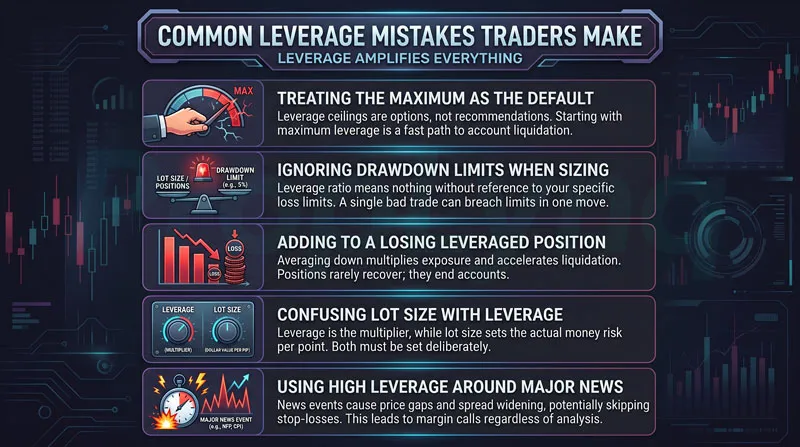
    Leverage amplifies everything — including mistakes. These are the patterns most consistently seen in traders who lose funded accounts or blow retail accounts early.
    Common Leverage Mistakes Traders Make

    Treating the maximum as the default. Most brokers and prop firms publish a maximum leverage ratio, not a recommended one. Using the ceiling as your starting point is one of the most reliable ways to end an account quickly. The ceiling exists as an option, not a suggestion.

    Ignoring drawdown limits when sizing positions. A funded account with a 5% daily loss limit and 1:100 leverage creates a situation where a single poorly sized trade can breach the daily limit in one move. The leverage ratio is meaningless without reference to the loss limit you are operating within. Those two numbers — leverage and drawdown — need to be thought about together, not separately.

    Adding to a losing leveraged position. Averaging down works in low-leverage, wide-stop environments with patient capital. In leveraged trading, each addition multiplies the exposure and accelerates the path to liquidation. The position either recovers or it ends the account — there is very little middle ground when leverage is involved.

    Confusing lot size with leverage. Two traders can use identical leverage but carry completely different risk exposure if they are trading different lot sizes. Leverage sets the multiplier; lot size determines the dollar value per pip movement. Both variables need to be set deliberately, not just one of them.

    Using high leverage around major news events. Events like Non-Farm Payrolls, central bank rate decisions, or CPI releases generate spread widening and price gaps. Stop-loss orders can be skipped entirely in these conditions — the market gaps past them without triggering the order at the expected price. High leverage during news events is one of the most reliable routes to a margin call that had nothing to do with your analysis being wrong. Before trading around scheduled releases, it is worth understanding how news trading in forex works at a mechanical level, particularly how spreads behave in the minutes before and after impact.

    Choosing the Right Leverage Level for Your Strategy

    There is no single correct leverage level for every trader or strategy. The right level depends on how you trade, what you trade, and the rules of the environment you are trading in. Working through these considerations before setting your leverage provides a practical starting framework.

    • Maximum loss per trade: What percentage of your account balance are you willing to lose on a single trade? Your position size — not your leverage — should enforce that limit. Leverage just determines how many units you can access per dollar of margin.
    • Instrument volatility: What is the average daily pip range or percentage move of the instrument you are trading? Higher volatility requires lower leverage to keep individual trade risk constant across sessions.
    • Drawdown limit: If you are trading a funded account, what is the maximum drawdown allowed — and is it calculated on balance or equity? Equity-based drawdown, which includes open positions, tightens the real-world limit further than traders often realise.
    • Stop placement: Wide stops require lower leverage. A 100-pip stop on a 1:100 position in a $10,000 account is a $1,000 risk — 10% on one trade. The same stop at 1:10 is $100.
    • News and overnight exposure: Are you holding positions through scheduled news events or overnight? Both scenarios introduce gap risk that leverage magnifies significantly.

    A scalper using very tight stops on major pairs in the London or New York session can often justify higher leverage, because their maximum per-trade loss stays controlled by design. A swing trader holding positions over multiple days should use considerably lower leverage, because the position remains exposed to overnight gaps and multi-session moves that a stop may not fully contain. The question of which approach suits a prop challenge environment is something the guide on trading styles and prop challenges covers in detail — the interaction between leverage, style, and drawdown rules is not the same for every type of trader.

    A conservative starting point for traders new to leveraged instruments: no more than 1:5 to 1:10 for forex, and 2x to 5x for crypto. As consistency improves and position-sizing discipline becomes automatic, there is a measured case for adjusting leverage upward — but only after the underlying edge is proven across enough trades to mean something.

    What is Leverage mean in PropLynq challenges

    PropLynq’s challenge accounts allow a maximum leverage of 1:100 on the 2-Step Challenge — the platform’s most popular evaluation model. That ceiling gives traders meaningful position-sizing flexibility, but the structure around it is what traders actually need to internalise before they place their first trade.

    The 2-Step Challenge operates with a 5% daily loss limit and a 10% maximum total drawdown, both calculated on equity — meaning open floating P&L counts toward the limit, not just closed positions. On a $50,000 account, the daily limit is $2,500 and the total drawdown floor is $45,000. At 1:100 leverage, a single lot of EUR/USD carries roughly $10 of risk per pip. A 250-pip adverse move on a full lot — without a stop — would breach the daily limit on its own. Leverage and drawdown rules are not separate settings to configure once and forget; they are a system that must be treated as a whole.

    The BYOB model at PropLynq adds another dimension to this. Because traders connect their own broker account — from an approved list that includes IC Markets, Pepperstone, Exness, and others — the actual leverage available on a given instrument depends on both the PropLynq ceiling and the broker’s own limits for that account type. A trader using a regulated European broker will have a lower effective leverage than one using an offshore broker that offers 1:500 by default. The PropLynq cap of 1:100 acts as the governing ceiling regardless of what the broker would otherwise allow.

    Traders who maintain consistent performance scale automatically: after four consecutive months of profitable payouts, the funded account balance increases by 40%, with a path to a maximum allocation of $4,000,000. Reviewing the full structure on the PropLynq trading accounts page before choosing a challenge size helps ensure the account parameters match your actual trading style — not just the account size that looks appealing.

    Using Leverage Wisely: The Bottom Line

    Understanding what is leverage — not just the textbook definition, but how it multiplies gains, losses, and mistakes in equal measure — is the difference between using it as a precision instrument and treating it as an accelerator with no brakes.

    The traders who use leverage well are not the ones who use the most of it. They are the ones who know exactly what each trade does to their account at the leverage level they have set, and who never let that exposure exceed the risk they planned for before the session opened. Leverage is a tool. Like any tool, it is only as useful as the discipline behind it.

    Whether you are building a long-term forex strategy, exploring leveraged crypto markets, or preparing for a funded evaluation, the principle holds in every environment: start lower than you think you need to, let your edge prove itself across enough trades, and scale leverage only when your consistency genuinely earns it. If you are ready to apply that discipline under real evaluation conditions, the PropLynq challenge is structured specifically for traders who take position management seriously.

  • Static vs Trailing Drawdown: What Funded Traders Need to Know

    Static vs Trailing Drawdown: What Funded Traders Need to Know

    Most traders do not fail a funded challenge because they picked the wrong profit target. They fail because they misunderstood the rule that decides when the account is done. That is why static vs trailing drawdown matters more than many beginners realize. Two firms can advertise similar percentages, but the actual pressure on your trading can feel completely different once open profit, floating loss, and new equity highs start changing the room you have left. Static drawdown stays fixed. Trailing drawdown moves as the account reaches new peaks, and that changes how aggressively you can press trades or how much profit you can afford to give back. The confusion around static vs trailing drawdown is not academic. It affects position sizing, trade management, and whether a strategy that looks fine on paper is actually survivable inside a challenge.

    Static vs trailing drawdown: the short answer

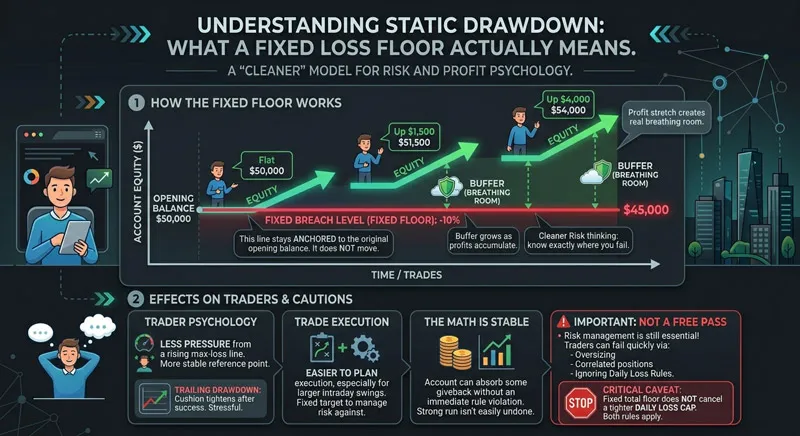
    Static drawdown is a fixed loss floor, usually anchored to the starting balance. If the account is allowed a $5,000 maximum drawdown on a $50,000 account, that breach line stays in the same place unless the firm’s rules say otherwise. Trailing drawdown is different. The loss floor moves up as the account reaches new balance or equity highs, which means your room can shrink even while you are making progress.

    That is the real answer to static vs trailing drawdown: static gives you a stable floor to work above, while trailing keeps ratcheting the floor upward as you perform. Static often feels easier to manage for traders who need normal price movement and some profit giveback. Trailing can reward discipline, but it can also punish loose trade management, especially when the rule is tied to equity rather than closed balance. Not every trailing rule works the same way, so the exact wording matters.

    What a fixed loss floor actually means

    Static drawdown is the simpler structure to understand because the breach level does not chase your profits. The firm sets a maximum total loss from the opening balance, and that floor stays fixed. On a $50,000 account with a 10% static max drawdown, the key line is $45,000. Whether you are flat, up $1,500, or up $4,000, the rule is still anchored to that original threshold. That gives traders a cleaner way to think about risk: the buffer between current equity and the fixed floor grows as profits accumulate.

    That does not mean static drawdown is loose or forgiving in every situation. A trader can still fail quickly by oversizing, stacking correlated positions, or ignoring daily loss rules. But static does remove one source of pressure that trailing models create: you are not watching the maximum-loss line rise every time the account makes a new high. For many traders, especially those who hold for larger intraday swings or allow trades time to develop, that fixed reference point makes execution easier to plan.

    What a fixed loss floor actually means

    It also changes the psychology of profit. Under a static structure, a winning stretch usually creates more real breathing room instead of simply dragging the breach line upward behind you. That is why traders often describe static vs trailing drawdown as a choice between a cushion that grows and a cushion that can tighten after success. The math is more stable, and the account can absorb some giveback without turning a strong run into an immediate rules problem. The catch is simple: static drawdown still needs to be read alongside the daily loss rule, because a fixed total floor does not cancel a tighter daily cap.

    Why a moving loss floor changes execution

    Trailing drawdown is the rule that catches traders who assume profits automatically create safety. Instead of leaving the loss floor fixed at the starting balance, trailing drawdown pushes that floor upward whenever the account reaches a new high. The basic formula is simple: highest balance or equity reached, minus the allowed drawdown amount. Once that line moves higher, it usually does not come back down after losses. That is why traders often describe trailing drawdown as a moving stop on the whole account rather than on one position.

    The detail that matters most is what the firm is trailing. Some firms trail closed balance only. Others trail real-time equity, which includes floating profit and floating loss. Equity-based trailing is tighter because open profit can lift the high-water mark before the trade is closed. If that trade reverses, the trader may discover that the account is much closer to the breach line than it looked a few minutes earlier.

    That is also why trailing drawdown changes trade management. It rewards consistency, but it can punish traders who let open winners swing too far back, pyramid too aggressively, or assume that unrealized profit is harmless until the position is closed. Under a static structure, early profits usually widen the cushion. Under a trailing structure, early profits can shrink the room left between current equity and the kill switch. In practical terms, static vs trailing drawdown is often a question of how much giveback your method can tolerate. The rule is not automatically bad, but it is less forgiving of sloppy execution and much more sensitive to how the firm defines the calculation.

    • Static drawdown stays anchored to the starting balance.
    • Trailing drawdown ratchets upward when the account hits new highs.
    • Balance-based trailing is usually easier to track than equity-based trailing.
    • Floating P&L can matter before a trade is closed if the rule is equity-based.

    Static vs trailing drawdown comparison table

    A side-by-side view makes the real difference easier to see in static vs trailing drawdown. The headline percentage alone rarely tells the full story. What matters is whether the breach line stays fixed or climbs with performance.

    Feature Static drawdown Trailing drawdown
    Reference point Starting balance Highest balance or equity reached
    Does the loss floor move? No, it stays fixed Yes, it ratchets upward with new highs
    What happens after profits? Your cushion usually grows Your breach line often moves closer
    Tracking difficulty Simpler Higher, especially if equity-based
    Open-trade sensitivity Depends on firm rules, but usually less punishing structurally Can be very sensitive if floating equity is included
    Best fit tendency Traders who need room for normal pullback and trade development Traders who keep risk tight and manage profit giveback aggressively

    The simplest way to read this table is to ask one question: does my strategy need breathing room after I make progress, or can I live with a floor that rises behind me? That answer usually matters more than the marketing language around the account.

    A $50,000 example: same P&L, different drawdown outcome

    Assume two traders each start with a $50,000 account and a $5,000 maximum loss allowance. This is where static vs trailing drawdown becomes expensive. On the static account, the hard floor is $45,000 and it stays there. On the trailing account, the floor starts at $45,000 too, but it moves up whenever the account prints a new high. The traders follow the same path.

    First, both traders make $3,000. Their account reaches $53,000. On the static account, the loss floor is still $45,000, so there is now $8,000 of room between current balance and the breach line. On the trailing account, the floor ratchets up to $48,000 because the allowed loss still trails by $5,000 from the new high. The trader feels ahead, but the usable cushion is smaller than it looks.

    Next, both traders give back $4,500 during a rough stretch. Their account drops to $48,500. The static account is still alive with $3,500 of room left before breach. The trailing account is now only $500 above the line. One more normal pullback, one spread spike, or one stubborn hold can end the challenge.

    Now imagine the trader briefly hits $54,200 in open equity before closing lower. On an equity-based trailing model, that temporary high can pull the floor up again even if the final closed balance does not hold the move. That is the part traders miss. The same P&L path can feel manageable under static drawdown and much tighter under trailing drawdown because the rule itself changes the room available after success.

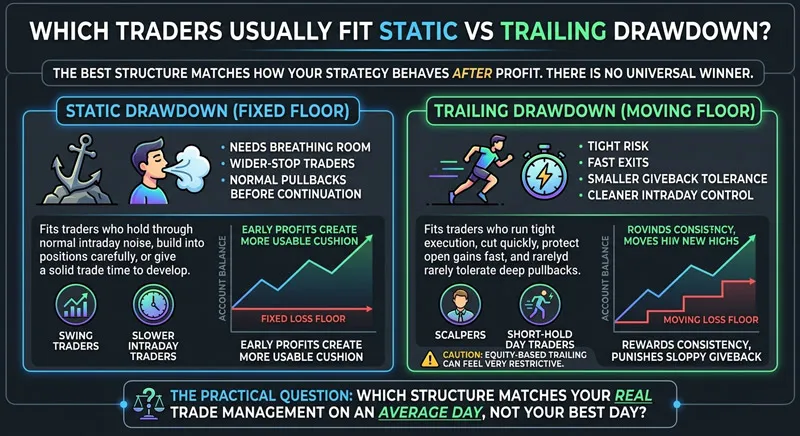
    Which traders usually fit static vs trailing drawdown?

    There is no universal winner in static vs trailing drawdown. The better structure is usually the one that matches how your strategy behaves after it goes into profit. Traders who need positions to breathe often prefer a fixed floor. Traders who cut quickly, protect open gains fast, and rarely tolerate deep pullbacks may be more comfortable with a moving one.

    Which traders usually fit static vs trailing drawdown

    Static drawdown usually fits traders who hold through normal intraday noise, build into positions carefully, or give a solid trade time to develop. Swing traders and slower intraday traders often value the fact that early profits create more usable cushion instead of dragging the account-level loss floor upward. That does not make static easy. It just makes the risk envelope easier to read.

    Trailing drawdown usually fits traders who already run tight execution. Scalpers, short-hold day traders, and traders who actively defend open equity may find it workable because the rule rewards consistency and punishes sloppy giveback. But this is the catch: if your style depends on watching an open winner float, pull back, and then continue, trailing can feel restrictive very quickly, especially when the rule is based on equity rather than closed balance.

    • Static drawdown tends to fit: traders who need breathing room after gains, wider-stop traders, and strategies with normal pullback before continuation.
    • Trailing drawdown tends to fit: traders with tight risk, fast exits, smaller giveback tolerance, and cleaner intraday control.

    The practical question is not which rule sounds easier in marketing. In static vs trailing drawdown, ask which structure matches your real trade management on an average day, not your best day.

    How PropLynq account types map to each rule

    On PropLynq’s live comparison table, the split is fairly clear. For PropLynq readers, static vs trailing drawdown is visible in the product mix, not just in theory. Stellar 2-Step is listed with a 5% daily loss limit and 10% max drawdown. Stellar 1-Step is listed with a 3% daily loss limit and 6% max drawdown. The same table also shows Stellar Lite at 4% daily loss and 8% max drawdown, while Instant Funding is shown with no daily loss limit and a 6% trail. Inside PropLynq, static vs trailing drawdown is not an abstract distinction. The evaluation-style accounts use fixed maximum-drawdown language, while Instant Funding is the program explicitly labeled as trailing.

    The public published evaluation rules make the fixed-side wording more concrete. PropLynq says total drawdown is calculated from the initial starting balance. It also says daily drawdown is measured from equity at the start of each trading day at 00:00 UTC, and that both floating and realized P&L count. That matters because a trader can have a fixed total drawdown structure while still being monitored with equity-based daily-loss logic.

    For readers comparing account types, the practical move is to compare PropLynq challenge types first, then read the exact rule wording. The plan table tells you which structure you are likely dealing with. The rules page tells you how tightly that structure is enforced in real trading conditions. If you want the full setup and broker-monitoring context, how PropLynq works also confirms the BYOB model, 10+ approved brokers, read-only MT5 investor-password monitoring, and unlimited time across Stellar challenge phases.

    Decision checklist before you buy a funded challenge

    Before you pay for any account, run through this checklist. Most confusion around static vs trailing drawdown comes from traders reading the percentage and skipping the calculation method. If a firm cannot explain this clearly, static vs trailing drawdown is exactly where the hidden friction usually sits.

    • Is the max loss floor fixed from the starting balance, or does it trail behind new highs?
    • Does the firm calculate the rule from balance or equity?
    • Do floating profits and floating losses count before trades are closed?
    • Is there also a separate daily loss rule that can breach the account sooner?
    • If the rule trails, does it stop at breakeven or keep moving under specific conditions?
    • How does the rule fit your real trade style: wider holds, quick scalps, or something in between?
    • What happens after you get funded, and how do payouts work once you are consistent?

    That last point matters more than many traders expect. A challenge is not just about passing. It is about whether the rule set still makes sense after funding. On PropLynq’s live pages, the payout structure is public: the site shows a $50 minimum withdrawal, multiple withdrawal methods, zero fees, and a 24-hour processing guarantee on the payout schedule and methods page.

    If a firm answers these questions clearly, you are dealing with a rules page worth trusting. If the wording stays vague, assume the rule will feel worse in practice than it looks in marketing.

    Final takeaway on static vs trailing drawdown

    The cleanest way to think about static vs trailing drawdown is this: static keeps the loss floor fixed, while trailing keeps moving it upward as the account makes new highs. Neither rule is automatically better. The better rule is the one your strategy can survive without forcing bad trade management.

    For most traders, the safest move is to stop comparing headline percentages and start reading the calculation method. Check whether the rule is based on balance or equity, whether floating P&L counts, and whether the account uses a fixed max-drawdown model or a trail. That is where static vs trailing drawdown becomes a real trading decision instead of a marketing label.

    If you are comparing live account options, start with the rule wording, then confirm the plan structure and payout details before you buy.

  • 1-Step vs. 2-Step prop firm challenge Explained

    1-Step vs. 2-Step prop firm challenge Explained

    Choosing between a 1-step and 2-step prop firm evaluation sounds simple, but a 1-step vs 2-step prop firm challenge comparison becomes clearer only after you look past the headline. What matters more is the rule package behind the challenge: the profit target, daily loss limit, max drawdown, leverage, and the amount of pressure you feel while trying to pass. PropLynq offers both Stellar 1-Step and Stellar 2-Step, which makes it a useful real-world example for explaining how these account types differ in practice.

    A 1-step evaluation gives you one phase to qualify for funding. A 2-step evaluation makes you pass two separate phases, usually with the goal of testing both performance and consistency. On PropLynq, the one-step route is shorter, but it runs inside tighter risk limits. The two-step route takes longer, but it gives more room on daily loss, max drawdown, and leverage. That trade-off is what beginner traders actually need to understand before buying a challenge.

    1 step vs 2 step prop firm challenge: the short answer

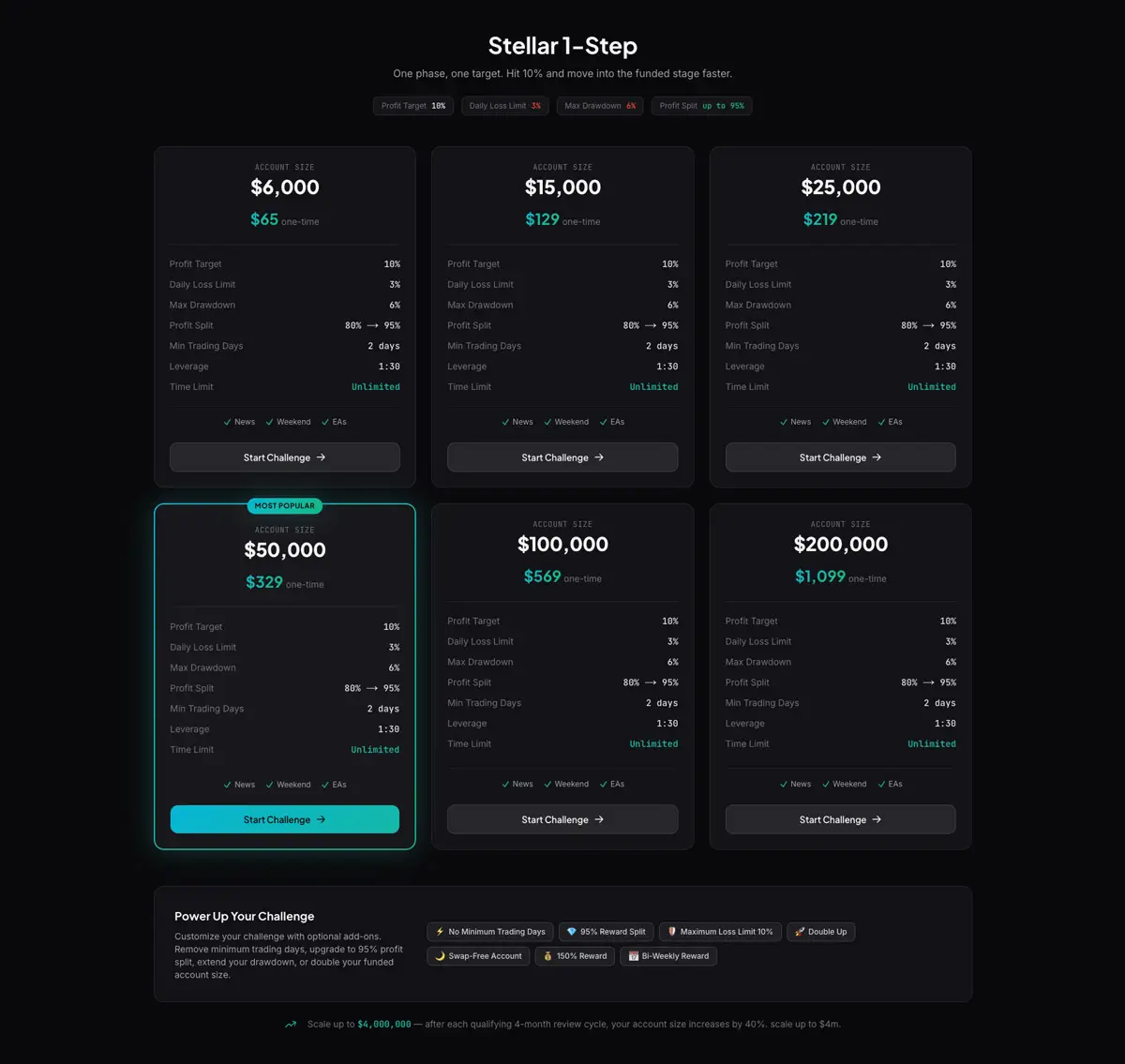
    A 1-step prop firm challenge is usually built for traders who want a more direct route to funding. At PropLynq, Stellar 1-Step is listed as a one-phase challenge with a 10% target, 3% daily loss limit, 6% max drawdown, 1:30 leverage, 2 minimum trading days, and unlimited time.

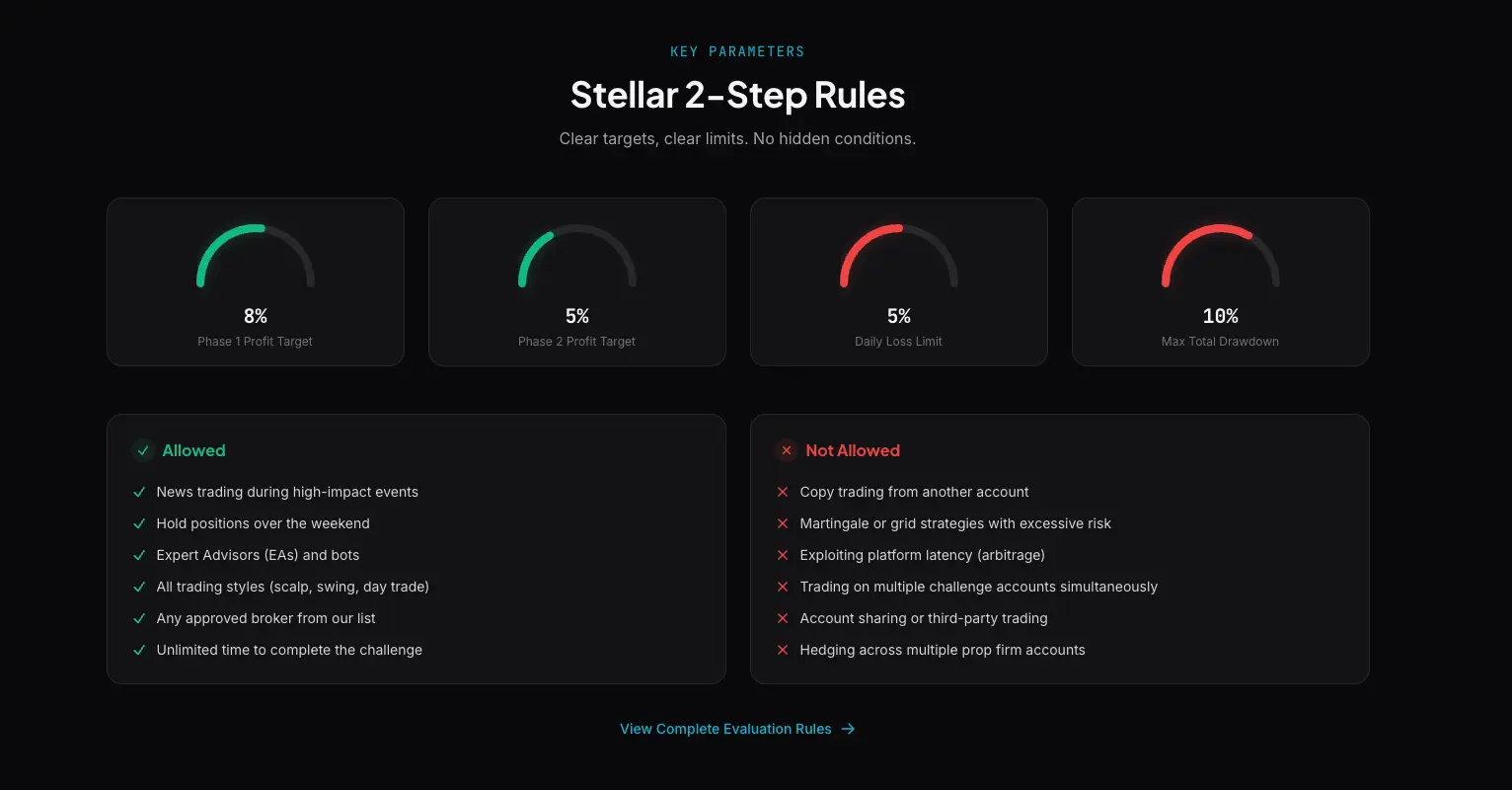
    A 2-step prop firm challenge is usually built for traders who want more room to trade, even if that means proving themselves over two phases instead of one. At PropLynq, Stellar 2-Step is listed with an 8% phase-1 target, 5% phase-2 target, 5% daily loss limit, 10% max drawdown, 1:100 leverage, 5 minimum trading days, and unlimited time.

    So the short answer in any 1-step vs 2-step prop firm challenge comparison is this: 1-step is faster on paper, while 2-step is roomier on paper. For beginners, the better option usually depends less on the number of phases and more on whether the risk limits match the way they already trade. That final judgment is an editorial conclusion based on PropLynq’s published rule differences.

    What a 1-Step Evaluation Looks Like at PropLynq

    In a 1-step vs 2-step prop firm challenge comparison, PropLynq’s Stellar 1-Step is the single-phase option. In the comparison table, it is shown with a 10% phase target, 3% daily loss limit, 6% max drawdown, 1:30 leverage, 2 minimum trading days, unlimited time, and an 80%→95% profit split. The same comparison area shows that news trading, weekend holding, and EAs / bots are allowed.

    That structure makes the appeal obvious. There is only one phase to clear, so the route to a funded account feels more direct. For a beginner, that can sound simpler than passing two separate phases. But the tighter risk box changes the difficulty. A one-phase model does not automatically mean an easier model. With only 3% daily loss and 6% max drawdown, the one-step format leaves less room for oversized positions, emotional trading, or sloppy risk control. That interpretation is an editorial inference from the published limits.

    What a 1-Step Evaluation Looks Like at PropLynq

    In a 1-step vs 2-step prop firm challenge comparison, the 2 minimum trading days requirement also matters. It means the account is not built around a long waiting period, and the unlimited time rule removes deadline pressure. But unlimited time does not weaken the risk rules. It only means the challenge does not expire while you work toward the target.

    What a 2-Step Evaluation Looks Like at PropLynq

    Within a 1-step vs 2-step prop firm challenge breakdown, PropLynq presents Stellar 2-Step as its most popular challenge and describes it as a two-phase path to prove consistency before funding. The trading accounts page lists it with 8% for phase 1, 5% for phase 2, 5% daily loss, 10% max drawdown, 1:100 leverage, 5 minimum trading days, unlimited time, and an 80%→95% profit split.

    For beginners, the biggest appeal of a 2-step model is not speed. It is breathing room. Compared with PropLynq’s 1-Step structure, the 2-Step account gives more room on both daily loss and maximum drawdown, while also offering higher leverage. That does not make it automatically easier, but it can make the account feel less restrictive for strategies that need more normal price movement before the setup works. That “breathing room” point is an editorial inference from PropLynq’s published rules.

    That trade-off is central to any 1-step vs 2-step prop firm challenge decision because you must pass two separate targets. PropLynq’s evaluation rules page lays out the structure clearly: 8% in phase 1, 5% in phase 2, with the same daily loss and drawdown framework and 5 minimum trading days. After phase 2 is completed, the trader moves to funding.

    1-step vs 2-step prop firm challenge: the differences that matter most

    The first difference is speed to funding. A 1-step account is naturally shorter because there is only one target to hit. At PropLynq, that means one phase at 10% instead of two phases at 8% and 5%. For a trader who can stay precise inside tighter limits, that makes 1-Step the more direct route.

    The second difference in a 1-step vs 2-step prop firm challenge comparison is drawdown room. PropLynq shows 3% daily loss and 6% max drawdown on 1-Step versus 5% daily loss and 10% max drawdown on 2-Step. For beginners, this can matter more than the phase count because it affects how much normal market movement the account can absorb before a rule breach.

    The third difference is leverage. PropLynq lists 1:30 leverage on 1-Step and 1:100 leverage on 2-Step. Higher leverage is not automatically better, but it does give more flexibility in position sizing. For traders who are still learning discipline, that can be either helpful or dangerous, depending on how well they control risk. The leverage figures are factual; the caution is editorial.

    The fourth difference in a 1-step vs 2-step prop firm challenge analysis is psychological pressure. The 1-Step model creates pressure through a tighter rule box. The 2-Step model creates pressure through a longer process. Some traders prefer the urgency of one phase. Others perform better when the structure gives them more room, even if they must prove themselves twice. That comparison is an editorial inference from the published rules.

    Which one is better for beginner traders?

    For most beginners, the better 1-step vs 2-step prop firm challenge option is the one that allows them to execute a simple strategy without forcing bad habits. Based on PropLynq’s published numbers, the 2-Step model looks more forgiving on risk limits, while the 1-Step model looks more direct but tighter.

    That is why “better for beginners” does not automatically mean “fewer steps.” A beginner who is still learning position sizing, patience, and emotional control may find the 2-Step format easier to manage because it provides more room on drawdown and leverage. A beginner who already trades with tight control and does not need much leverage may prefer the 1-Step path because it removes the second phase and only requires 2 trading days. That fit judgment is editorial, based on PropLynq’s published structure.

    One extra layer matters in any 1-step vs 2-step prop firm challenge comparison: PropLynq says its drawdown framework is equity-based, not just balance-based, and that both floating and realized P&L count. That means tighter-loss accounts can feel harder in live execution than they look in a feature table, especially for beginners who hold trades through temporary drawdown.

    1-step vs 2-step prop firm challenge rule details traders often miss

    When traders compare a 1-step vs 2-step prop firm challenge, they often focus on the headline numbers and skip the mechanics underneath. On PropLynq’s evaluation rules page, the firm says every rule is public and measurable. It also explains that daily drawdown is measured from equity at the start of the day, not only from closed balance, and that both floating and realized P&L count because the model is equity-based.

    The next detail beginners often miss is minimum trading days. On PropLynq, 1-Step requires 2 days while 2-Step requires 5 days. That means a trader cannot assume a quick target hit is enough by itself; the account still has to satisfy the minimum-day condition unless an add-on changes that requirement. PropLynq also advertises optional add-ons like removing minimum trading days, upgrading to a 95% reward split, extending drawdown, and doubling funded account size.

    1-step vs 2-step prop firm challenge rule details traders often miss

    Another overlooked point is the difference between flexibility and anything-goes trading. PropLynq states that news trading, weekend holding, EAs, and multiple trading styles are allowed, but its comparison and rules pages also list restrictions such as copy trading from another account, excessive martingale or grid strategies, platform-latency exploitation, account sharing, and cross-firm hedging.

    The final point many beginners miss in a 1-step vs 2-step prop firm challenge review is the business model itself. PropLynq’s risk disclosure says challenge accounts run in a simulated trading environment, that buying a challenge does not mean opening a brokerage account with PropLynq, and that the firm’s monitoring access is read-only under its BYOB model. The risk disclosure also states that challenge fees are non-refundable once trading has commenced, that many traders do not pass, and that purchasing a challenge does not guarantee funding or profitability.

    How to Compare More Than Just the Evaluation

    Once you understand the evaluation rules, the smarter move in any 1-step vs 2-step prop firm challenge comparison is to compare the rest of the setup too. PropLynq’s bring-your-own-broker model means traders choose from approved brokers, connect their own MT5 account, and let PropLynq monitor activity through a read-only connection. The how-it-works page says this monitoring cannot place trades, modify orders, or withdraw funds.

    PropLynq also says traders can use instruments available at their chosen broker, including forex pairs, indices, metals, energies, and crypto CFDs, and that EAs and algorithmic trading are allowed on most challenge types. For beginners, that matters because broker fit and instrument access can be just as important as the evaluation model itself.

    Then there is the payout structure. PropLynq says funded traders can keep up to 95% as they scale, and its how-it-works FAQ says Stellar 1-Step rewards are available every 5 business days, while Stellar 2-Step rewards start after 21 days and continue every 14 days. The payouts page also advertises a 24-hour processing guarantee, 85+ countries served, multiple withdrawal methods, and zero fees.

    Finally, PropLynq says funded traders can scale accounts up to $4,000,000, and both the homepage and how-it-works page repeat that scaling and up to 95% reward language. For a beginner, that means the decision should not stop at “Which challenge is easier to pass?” It should also include “Which challenge makes the most sense if I actually stay funded and grow?”

    A Simple Checklist Before You Choose

    Before buying a challenge, ask these five questions.

    Can I hit the target without forcing trades? If your setup needs more time and more price movement, the tighter 1-Step limits may feel restrictive. If your entries are already selective and controlled, the shorter one-phase route may suit you. The underlying numbers come from PropLynq’s comparison table; the fit judgment is editorial.

    Can I manage equity-based drawdown in real time? PropLynq says floating and realized P&L both count, so open trades can affect your loss limits before you close them.

    Does leverage help my strategy, or would it tempt me into overtrading? PropLynq publishes 1:30 on 1-Step and 1:100 on 2-Step. Higher leverage can create flexibility, but it can also magnify weak discipline.

    Do I care more about a shorter path or a more forgiving structure? 1-Step removes the second phase and only needs 2 days. 2-Step takes longer but offers more room on risk limits and leverage.

    Have I checked payouts, not just the evaluation? PropLynq’s payouts page promotes a 24-hour processing guarantee, zero fees, and multiple payout methods, while its how-it-works page explains that reward timing varies by model.

    Final Takeaway

    For beginner traders, the choice between a 1-step and 2-step evaluation is really a choice between speed and tighter control on one side, and more structure with more room on the risk limits on the other. On PropLynq.com , Stellar 1-Step is the more direct route, while Stellar 2-Step offers more room on drawdown and leverage but asks you to prove yourself over two phases.

    That means the better option is not the one with the cleaner headline. It is the one that fits the way you already trade. If your edge depends on precision and tight control, 1-Step may fit better. If you want more room to manage variance and you do not mind a longer evaluation, 2-Step may be the stronger choice. That final guidance is editorial, built on PropLynq’s published rules and risk disclosures.

    The practical next step is simple: compare the challenge structures side by side, then review the payout setup before committing. That gives you a more complete decision than choosing based on phase count alone.

  • How to Get a Funded Trading Account in 2026 and Scale Smart

    How to Get a Funded Trading Account in 2026 and Scale Smart

    Funded Trading Account remains one of the most attractive paths for new traders in 2026 because it offers access to larger capital without requiring a large personal trading account. In the retail funded-account world, that usually means joining a prop firm, following a defined ruleset, and earning a profit split if you trade consistently within the firm’s risk limits.

    That opportunity is real, but it is often misunderstood. A funded account is not simply “free capital.” It is capital attached to an evaluation process, loss limits, payout rules, and performance pressure. Many beginners focus on the advertised account size and overlook the details that determine whether they can keep the account long enough to benefit from it.

    The right way to think about funded accounts is not “Which firm has the biggest number?” (Definitely PropLynq !)but “Which funding model fits my strategy, my risk tolerance, and my ability to stay disciplined?” That question matters more than any headline discount or oversized account promise. A trader who chooses the right structure can build consistency, qualify for payouts, and work toward larger capital allocation. A trader who chooses the wrong structure usually discovers it through broken rules, avoidable drawdown, and unnecessary stress.

    What funded trading accounts in 2026 means for beginners

    For most retail traders, funded account no longer looks like a traditional institutional desk role. It usually means entering a structured funded-account environment where the firm defines the account model, the drawdown rules, the payout structure, and the scaling path. Your job is to show that you can trade responsibly inside that framework.

    That changes what success looks like. In prop trading, success is rarely about one huge trade. It is about surviving the evaluation, protecting the funded account, qualifying for withdrawals, and showing enough stability to earn more capital over time. In other words, process matters more than excitement.

    This is why the most important part of funded accounts is often the least glamorous part. New traders tend to pay attention to “instant funding,” “high profit split,” or “scale to millions.” Those details matter, but only after you understand the rules underneath them. A high account balance does not help much if the drawdown model is too tight for your strategy. A generous profit split is less valuable if the payout timing, minimum trading-day requirements, or platform restrictions do not fit how you actually trade.

    The appeal is still obvious. Funded accounts reduce the need to risk large personal capital. They also create structure, and that structure can improve a trader’s habits. Clear rules force better position sizing, better self-control, and more honest feedback. If you can follow a plan, funded accounts can help you build discipline faster than loosely managed self-funded trading.

    The same structure can also expose weak habits very quickly. Traders who chase targets, overleverage, revenge trade, or constantly switch strategy usually struggle in funded environments because the loss limits are not theoretical. A prop firm is effectively asking one question: can you manage risk well enough to deserve more capital? If the answer is yes only when conditions are perfect, the funded trading account model will usually reveal that sooner rather than later.

    How to get a funded trading account in 2026

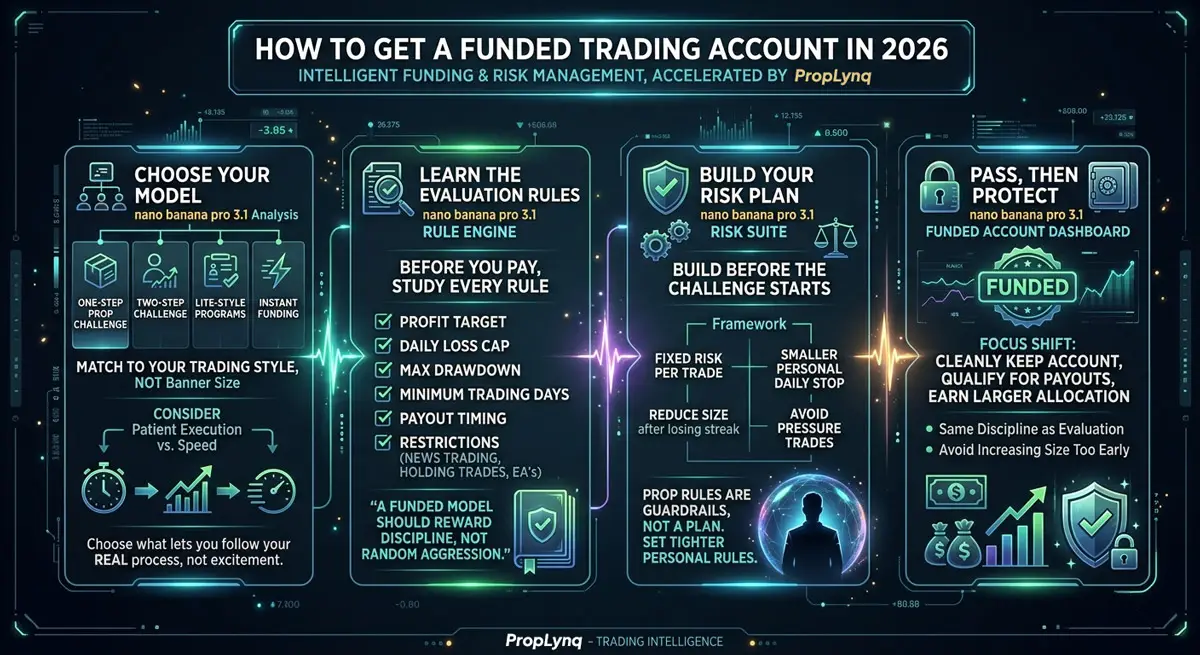
    Getting a funded trading account is usually less about finding a shortcut and more about proving that you can operate inside a professional ruleset. The exact path differs by firm, but the logic is usually the same: choose the right model, understand the funded account evaluation process, prepare your own risk plan, pass the challenge or meet the funding criteria, and then protect the account once you have it.

    How to get a funded trading account in 2026

    1. Choose the model that fits your trading style

    The first decision is not which firm advertises the biggest balance. It is which account structure gives you the best chance of trading your existing setup without forcing bad behavior.

    A one-step prop challenge usually appeals to traders who want a quicker route and can handle tighter pressure. A two-step challenge spreads the process over more than one phase, which can suit traders who prefer a slower proof-of-consistency path. Lite-style programs often sit between flexibility and pressure. Instant-funding accounts remove the pre-funding evaluation phase, but they still come with strict loss limits and their own commercial trade-offs.

    The key is fit. If your strategy needs patience and controlled execution, a slower evaluation can help you trade more naturally. If you are already consistent and want faster access to capital, instant funding may be worth evaluating. The best choice is the one that lets you follow your real process, not the one that sounds the most exciting in a banner.

    2. Learn the evaluation process before you pay

    Many beginners make the same mistake: they buy a prop challenge first and study the rules later. That is backwards.

    Before paying for any prop account, read the full rule structure and ask a simple question: can I realistically execute my strategy inside these limits without forcing trades? That means checking the profit target, daily loss cap, maximum drawdown, minimum trading days, payout timing, and any restrictions around news trading, holding trades, expert advisors, or platform use.

    If you need to trade very differently just to survive the account, the problem is not motivation. The problem is fit. A funded-account model should reward disciplined execution. It should not push you into random aggression just to satisfy a number.

    3. Build your risk plan before the funded account challenge starts

    Once you understand the funded account rules, build your own plan before the challenge begins. That plan should cover position sizing, maximum risk per trade, maximum number of trades per day, market conditions you will avoid, and what you will do after a losing streak.

    This step matters because prop rules are guardrails, not a trading plan. If the firm says you can lose a certain amount in a day, that does not mean you should trade anywhere near that limit. Strong traders usually set tighter personal rules than the firm requires. They think in terms of preserving optionality, not using every inch of allowed drawdown.

    A simple framework works well for most beginners in most prop firms:

    • define a fixed maximum risk per trade
    • define a smaller personal daily stop than the firm’s hard limit
    • reduce size after a rough day or a sequence of poor executions
    • avoid trading just because you feel pressure to “make progress”

    4. Pass, then protect

    Passing a funded account challenge is not the finish line. It is the point where a different kind of discipline starts. Once funded, the focus should shift from “How fast can I hit another target?” to “How cleanly can I keep this account, qualify for payouts, and earn larger allocation over time?”

    That means using the same risk discipline that got you there. Many traders pass an evaluation, feel relief, then increase size too early because the funded account feels more valuable. That is one of the fastest ways to lose the opportunity they worked for.

    Common beginner mistakes in funded trading accounts

    Most failures happen for simple reasons:

    1. risking too much to hit the target quickly
    2. ignoring payout rules until after passing
    3. choosing a firm because of discounts instead of rule fit
    4. changing strategy in the middle of the challenge
    5. treating one strong week as proof of long-term readiness

    A funded account is usually earned through repeatable execution, not dramatic performance. The traders who last are the ones who protect the account first and treat capital allocation as something to deserve, not something to gamble with.

    Funded account requirements you should check before buying

    The most important proprietary trading firm requirements are usually not the most visible ones on the sales page. What matters most is whether the rules are clear, realistic, and compatible with the way you trade.

    Start with drawdown. This is often the single most important rule because it determines how much normal market fluctuation your strategy can survive. Two firms can advertise similar account sizes but feel completely different in practice if one uses a tighter or less forgiving drawdown structure.

    Next, compare the relationship between the profit target and the allowed loss. If the target is ambitious relative to the drawdown limit, traders often feel forced to take poor-quality setups just to progress. A funded trading account challenge should still require skill, but it should not quietly reward desperation.

    Then check the timing rules. Are there minimum trading days? Is there a time limit to pass? Is there an inactivity rule? Do you have to wait for a particular payout window before withdrawing? These rules can change how you pace the account, and they matter more than many beginners expect.

    Operational fit matters too. Look at the platform, the broker setup, whether expert advisors are allowed, whether certain styles are restricted, and whether the firm clearly explains how the environment works. The more visibility you have before purchase, the easier it is to make a rational decision.

    A simple checklist helps:

    • How is drawdown measured?
    • What is the daily loss limit?
    • What is the maximum drawdown?
    • Are there minimum trading days?
    • Is there a time limit?
    • When do payouts become available?
    • Are there restrictions on your strategy, platform, or tools?
    • Is the scaling plan clearly explained?

    These requirements are not just policy details. They tell you what type of trader the firm is actually trying to fund. Clear rules usually signal a more professional environment. Vague or hard-to-interpret rules often create problems later, especially for beginners who assume the marketing page tells the whole story.

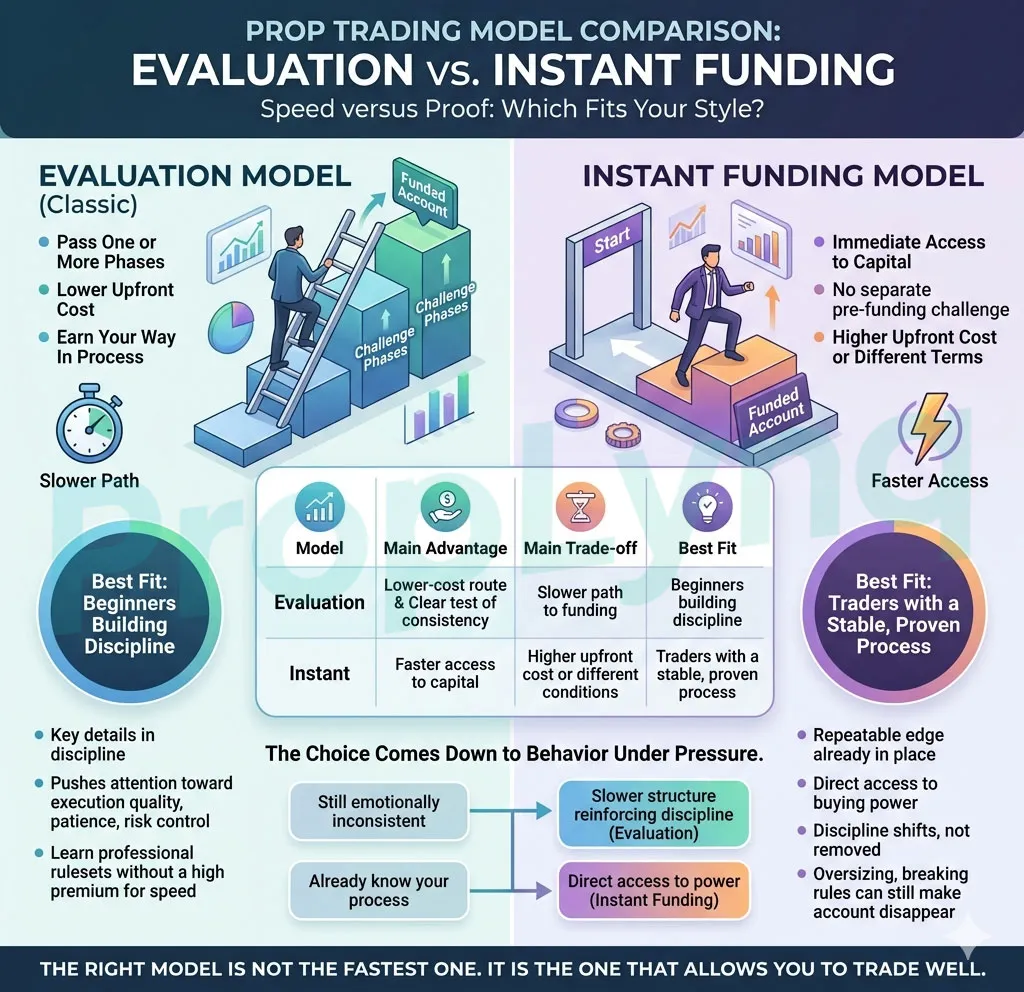
    Evaluation vs instant funding: which one fits your style?

    One of the biggest decisions in funded account trading is whether to choose a classic evaluation model or go straight to instant funding. The difference is usually framed as speed versus proof.

    Checklist of funded account trading requirements for beginners

    Evaluation models ask you to pass one or more phases before you receive a funded account. That usually means a lower upfront cost and a more traditional “earn your way in” process. Instant funding gives immediate access to an account without a separate pre-funding challenge, but that speed usually comes with a higher upfront cost or different commercial terms. It does not remove the need for discipline. It simply changes when the screening happens.

    Here is the practical difference:

    Model Main advantage Main trade-off Best fit
    Evaluation Lower-cost route and a clear test of consistency Slower path to funding Beginners building discipline
    Instant funding Faster access to capital Higher upfront cost or different conditions Traders with a stable, proven process

    An evaluation model often makes more sense when the main goal is learning how to trade inside a professional ruleset without paying the highest premium for speed. It can also help slow down traders who tend to rush. Because the challenge has to be passed first, it naturally pushes attention toward execution quality, patience, and risk control.

    Instant funding can make sense for traders who already have a repeatable edge and want faster access to buying power. The mistake is assuming “instant” means “easy.” It usually removes the qualifying stage, not the consequences of poor trading. If you oversize, break rules, or ignore the drawdown structure, the account can still disappear quickly.

    This choice comes down to behavior under pressure. Traders who are still emotionally inconsistent often do better in a slower structure that reinforces discipline. Traders who already know their process may value direct access more. The right model is not the fastest one. It is the one that allows you to trade well.

    How to scale without losing the funded account

    Scaling is one of the biggest reasons traders enter funded account firms, but it is also one of the easiest places to become unrealistic. A scaling plan is not permission to trade harder. It is a system for increasing capital allocation after you prove that your current level is under control.

    That distinction matters because many traders think scaling begins when they get funded. In reality, scaling begins with the habits that make a funded account survivable: stable position sizing, controlled losses, consistent execution, and the ability to stay patient when the market is not offering much.

    The first rule of scaling is simple: protect the account before trying to grow it. That means thinking like a risk manager first. If the firm allows a certain level of loss, your personal rules should usually be tighter. The closer you live to the hard limits, the less room you have to recover calmly.

    A practical scaling framework looks like this:

    1. trade small enough that normal losing streaks do not threaten the account
    2. maintain the same process through ordinary weeks, not only when conditions are ideal
    3. reduce size when execution quality slips
    4. increase only after a meaningful run of disciplined performance
    5. judge progress by stability, not by one strong payout cycle

    The psychological side is just as important as the numerical side. During the evaluation phase, traders often fear failing. During scaling, they often fear giving back progress. Both states can produce the same bad behavior: hesitation, impulsive trades, forced setups, or abandoning a plan that was working.

    That is why scaling plans should include behavioral rules, not just financial ones. Examples include stopping after a defined loss threshold, lowering size after consecutive red days, journaling emotional state alongside trade execution, and avoiding “celebration risk” after a strong period. Bigger capital amplifies mistakes just as easily as it amplifies gains.

    The traders who reach larger allocation are usually not the ones chasing every milestone. They are the ones who make the firm comfortable giving them more room. In funded account, trust is built through repeatability.

    How to compare prop firms in 2026 — and where PropLynq fits

    When comparing prop firms, beginners often start with discounts, account size, or the boldest promotional message. A better process is to compare five things in order:

    1. account model
    2. drawdown structure
    3. timing rules
    4. payout mechanics
    5. scaling logic

    That shortlist is simple, but it is usually enough to eliminate poor fits quickly.

    Start with the prop firm account model. Does the firm offer one-step, two-step, lite, or instant-funding options? Then examine the risk structure. What are the daily loss and maximum drawdown limits, and do they suit the way you trade? After that, move to timing. Are there minimum trading days or inactivity rules? Is there a deadline to pass? How soon can you request a payout? Finally, check whether the scaling path is clearly explained or buried in vague marketing language.

    Rule clarity is one of the strongest trust signals in this category. A firm does not need to offer the biggest numbers to be worth considering. It does need to make the product understandable before purchase. Serious traders care more about transparency than hype because unclear rules are expensive.

    Viewed through that lens, PropLynq currently presents a fairly straightforward offer. Its site shows four account paths — Stellar 2-Step, Stellar 1-Step, Stellar Lite, and Instant Funding — along with published model comparisons. The broader site positioning includes challenge-based allocation up to $300K, scaling up to $4M, and profit split language up to 95%, alongside a simulated-environment disclosure.

    Its live pages also publish several details beginners usually need in order to compare firms properly: no time limit on the main challenge models, instant setup language, read-only monitoring, a visible payouts page, and a defined scaling framework. The site also highlights broker flexibility through an approved-broker structure rather than a one-broker-only approach.

    That does not mean a trader should sign up on branding of a prop trading firm alone. The more sensible next step is to compare the available account models, decide which structure fits your trading style, and then read the payout conditions carefully before making a purchase. For PropLynq, that naturally points to the Trading Accounts page first and the Payouts page second.

    The broader lesson is useful beyond any single firm. The best prop firms for professional traders are rarely the ones with the loudest marketing. They are the ones that make it easy to understand the rules, evaluate the payout structure, and judge the scaling path in advance. Beginners who borrow that professional screening mindset usually make much better decisions.

    FAQ

    Is funded trading account good for beginners?

    It can be, provided the beginner wants structure and is willing to trade inside strict rules. It is a poor fit for traders looking for a quick win or a way to avoid discipline.

    How hard is it to get a funded trading account?

    Usually harder than the marketing makes it look. The difficulty is less about opening the account and more about hitting the target without breaking loss rules.

    What are the most important prop firm requirements?

    Drawdown structure, daily loss limits, timing rules, payout conditions, and any restrictions on trading style or tools.

    Is instant funding better than an evaluation?

    Not automatically. It is faster, but speed does not remove the need for discipline. For many newer traders, an evaluation model is the more useful training ground.

    What should I check before joining a prop firm?

    Check the model, the drawdown rules, the payout structure, the timing rules, and whether the firm explains everything clearly enough to evaluate before purchase.

    Conclusion

    Funded trading account can be a strong route into funded trading, but only when it is treated as a decision about fit rather than a shortcut to larger capital. Traders who last are usually the ones who choose a model that matches their process, study the rules before paying, and build their scaling plan around preservation rather than speed.

    For readers comparing options, the most practical next step is to review account structure and payout rules side by side before committing. On PropLynq.com , that means starting with the Trading Accounts page, validating the withdrawal details on the Payouts page, and using the homepage for the broader overview.