Author: Miles Rowan Keene

  • How to Trade Forex News: A Practical Guide to News Trading in Forex

    How to Trade Forex News: A Practical Guide to News Trading in Forex

    Forex news can move a chart faster than any clean technical setup. A pair that was respecting structure five minutes ago can break through support, reverse through resistance, widen its spread, and trigger stops before a trader has time to think. That is why news trading in forex should never mean “guess the headline and click buy or sell.” It needs a process.

    The goal is not to predict every data release perfectly. The goal is to know which events matter, how price usually behaves around them, when execution risk is too high, and how much account risk you are willing to expose. For a funded trader, that last point matters even more because drawdown rules can be breached by floating losses, not just closed trades.

    This guide from PropLynq explains how to trade forex news with a practical framework: what to watch, when to avoid trading, how to build a plan before the release, and how to protect yourself from the two risks that usually hurt news traders most — slippage and emotional over-sizing.

    What News Trading in Forex Actually Means

    News trading in forex is the practice of planning trades around scheduled economic events, central-bank decisions, inflation reports, employment data, geopolitical shocks, or other information that can change expectations for a currency. The important word is “planning.” A trader who reacts blindly to a candle is not trading news; they are trading adrenaline.

    The forex market moves on expectations. If traders expect the Federal Reserve to keep rates high, the dollar may strengthen before the meeting even happens. If inflation data comes in far below expectations, the move may be sharp because the market has to reprice that assumption quickly. Sometimes the number is “good” but the currency falls because traders were positioned for an even stronger result. That is why the headline alone is not enough.

    A useful news trader looks at three layers when he is trading in the best prop firm. First, what is the market expecting? Second, how large is the surprise compared with that expectation? Third, does price confirm the idea after spreads and volatility settle? News trading in forex becomes more controlled when you treat the release as a volatility event rather than a magic signal.

    News trading in forex also has two different styles. Some traders position before the release because they have a directional thesis. Others wait until after the release and trade the reaction once the first violent movement has passed. The second approach is usually cleaner for beginners because it reduces the need to predict the number in advance.

    The Short Answer: How to Trade Forex News Without Gambling

    The safest way to approach news trading in forex is to prepare before the event, avoid the first chaotic seconds if you do not have a tested execution model, and only trade when the setup still makes sense after spread, stop distance, and account risk are included.

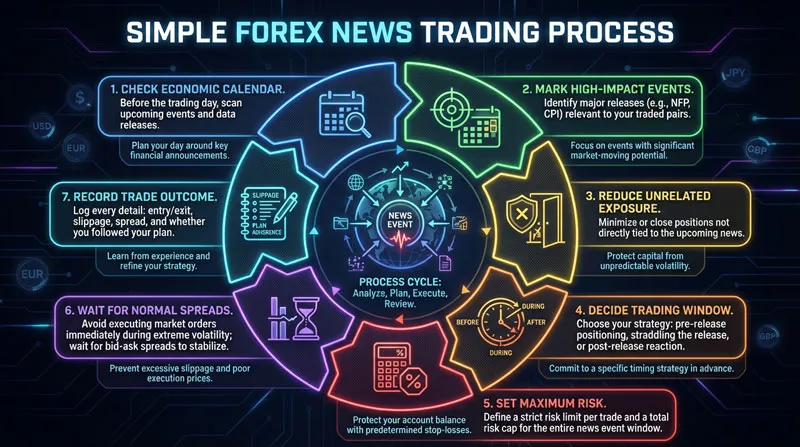
    A simple news trading in forex process looks like this:
    The Short Answer: How to Trade Forex News Without Gambling

    • Check the economic calendar before the trading day starts.
    • Mark high-impact events for the currencies you trade.
    • Reduce or close unrelated exposure before the release if the event can affect your pair.
    • Decide in advance whether you will trade before, during, or after the release.
    • Set a maximum risk per trade and a maximum risk for the whole news window.
    • Wait for spreads to normalize before using market execution.
    • Record the trade outcome, including slippage, spread, and whether you followed the plan.

    The best news traders are not the ones who catch every spike. They are the ones who know when not to trade. If the stop must be placed too wide, the spread is abnormal, or the pair is whipping both directions without structure, passing on the setup is a valid decision.

    The Forex News Events That Usually Matter Most

    In news trading in forex, not every calendar item deserves your attention. Some releases barely move the market. Others can change the entire session. The events below tend to matter because they affect interest-rate expectations, growth expectations, inflation pressure, or risk sentiment.

    News event Why it matters Pairs often affected Main trading risk
    Central-bank rate decisions They can change interest-rate expectations and forward guidance. Pairs involving that currency, especially USD, EUR, GBP, JPY, CAD, AUD, NZD, and CHF pairs Fast repricing, wide spreads, and reversals during the press conference
    Inflation data such as CPI or PCE Inflation affects the market’s view of future rate cuts or hikes. Major pairs and crosses tied to the reporting country Large first move followed by a second move if details contradict the headline
    Employment data such as NFP Jobs data can shift growth and rate expectations at the same time. USD pairs, gold, indices, and risk-sensitive currencies Whipsaws caused by mixed unemployment, wage, and payroll figures
    GDP and retail sales They show growth momentum and consumer demand. Currency of the reporting economy and its major crosses Delayed reaction if the market focuses on revisions or subcomponents
    Geopolitical or unscheduled news Unexpected events can create risk-off movement across markets. Safe-haven currencies, commodity currencies, gold, oil-sensitive pairs Gaps, poor liquidity, and no time to prepare

    For traders still choosing which markets to focus on, major pairs usually offer better liquidity and tighter spreads than many exotic pairs. PropLynq’s guide to major forex currency pairs is a useful companion because news trading in forex is much harder when the pair already has unstable spread behavior before the event.

    Three Ways to Trade Forex News

    There is no single correct method for news trading in forex. What matters is whether the method fits your skill, execution speed, risk limits, and broker conditions. Most traders fall into one of three approaches.

    1. Pre-news positioning

    In news trading in forex, pre-news positioning means entering before the release because your analysis suggests the market is mispriced. For example, you might believe the market is underestimating inflation risk and expect the currency to strengthen if the report confirms your view.

    This approach can produce a good entry if the thesis is right, but it carries the highest surprise risk. A slightly different number, a revised previous figure, or a conflicting subcomponent can invalidate the idea instantly. It is not enough to be “mostly right” if the spread widens and the stop is too close.

    2. Breakout trading during the release

    Breakout traders try to capture momentum as price breaks a level after the news hits. This can be done with market orders or pending stop orders. The attraction is obvious: when news creates real repricing, price can travel quickly.

    The risk is equally obvious. During the most volatile seconds, a buy stop or sell stop can be filled at a worse price than expected. If you use pending orders around news, review the logic in PropLynq’s guide to pending orders in forex and remember that the order type does not protect you from poor execution.

    3. Post-news continuation or reversal

    In news trading in forex, post-news trading waits for the initial spike to finish. The trader then looks for continuation after a clean break, or a reversal if the first move was overextended and rejected. This is often the most practical method for developing traders because it lets them see the market’s reaction before risking capital.

    The downside is that the “best” price may be gone. That is acceptable. In news trading in forex, a slightly later entry with clearer structure can be better than an early entry inside a spread explosion. A missed trade is cheaper than a badly executed trade.

    A Step-by-Step Process for News Trading in Forex

    A repeatable process for news trading in forex reduces the chance that a news event turns into a random bet. Use the steps below as a practical operating checklist.

    1. Start with the calendar. Before the session begins, identify high-impact events for the currencies you trade. Do not wait until a candle explodes to discover that CPI was scheduled.
    2. Define the affected pairs. If U.S. data is coming, USD pairs, gold, and risk assets may react. If the Bank of England is speaking, GBP pairs deserve attention. Avoid carrying correlated positions that all depend on the same news outcome.
    3. Mark the technical levels before the release. Identify the nearest range high, range low, liquidity sweep area, support, resistance, and invalidation point. Do this before emotions rise.
    4. Choose your trading mode. Decide whether you are avoiding the event, trading after the release, or using a specific tested news setup. Do not switch modes mid-spike because price looks exciting.
    5. Set the risk cap. Define the maximum amount you can lose if the news trade fails. For funded traders, this should consider both daily loss and total drawdown, not only personal comfort.
    6. Check spread and slippage conditions. If spread is too wide, either reduce size, widen the plan properly, or do not trade. PropLynq’s guide to slippage in forex explains why fast markets can fill orders away from the expected price.
    7. Wait for confirmation. Confirmation might be a candle close, a retest, a lower-timeframe structure shift, or a failed breakout. The rule depends on your system, but it must be defined before entry.
    8. Log the execution. Record the planned entry, actual fill, spread, stop distance, result, and whether the trade followed your rule. Without that data, you cannot tell if your news trading in forex has an edge or just occasional lucky wins.

    Scenario Example: Trading NFP Without Chasing the First Candle

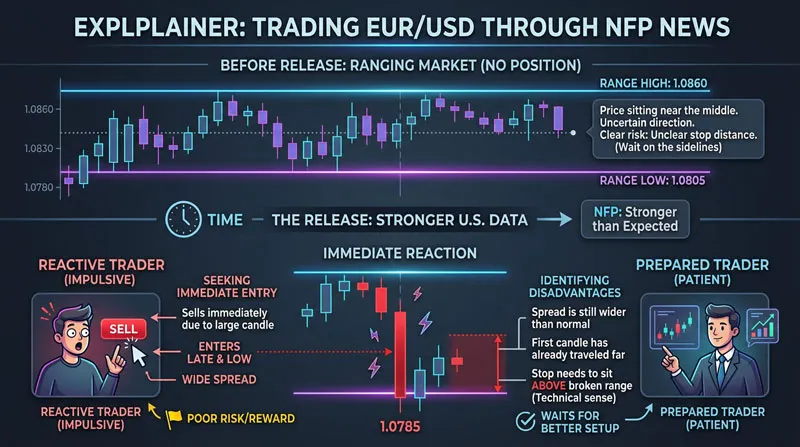
    Imagine EUR/USD is ranging before U.S. Non-Farm Payrolls. The range high is 1.0860, the range low is 1.0805, and price is sitting near the middle. You have no position before the release because the stop distance is unclear and the number could move the pair in either direction.

    The data comes out stronger than expected. EUR/USD drops hard, breaks the range low, and trades into 1.0785 within seconds. A reactive trader sells immediately because the candle is large. A prepared trader waits. The spread is still wider than normal, the first candle has already traveled far, and the stop would need to sit above the broken range to make technical sense.
    Scenario Example: Trading NFP Without Chasing the First Candle

    Five minutes later, price retests the old range low near 1.0805 and fails to reclaim it. Spread has narrowed. The trader now has a clearer plan: sell the failed retest, place the stop above the retest high, and target the next support zone. This trade may still lose, but it is no longer just a reaction to the headline. It has structure, invalidation, and measurable risk.

    The lesson is simple: in news trading in forex, the first move is not always the best trade. Sometimes the higher-quality opportunity appears after the market reveals whether the breakout is accepted or rejected.

    Risk Controls Funded Traders Need During News

    In news trading in forex, volatility is not automatically bad. Uncontrolled exposure to news volatility is the problem. Funded traders should be especially careful because a trade can breach rules through open equity movement before it ever closes.

    PropLynq’s evaluation rules explain that daily drawdown is measured from equity at the start of the trading day and that floating and realized P&L count toward drawdown checks. That matters during news because a temporary spike against your position can still damage the account even if price later returns.

    Use these controls before trading a high-impact release:

    • Reduce risk per trade. A normal 1% risk may be too large if the spread and slippage environment is abnormal.
    • Avoid stacking correlated trades. Buying GBP/USD and selling USD/CAD before the same U.S. release may create one large dollar bet, not two independent trades.
    • Respect the stop location. Do not tighten the stop randomly just to make the lot size bigger. If the technical stop is too wide, the trade may not fit.
    • Set a daily news limit. Decide how many attempts you are allowed during the event. Two failed attempts may be enough.
    • Check account rules before the trade. If your account is already close to a daily loss limit, the correct news trade may be no trade.

    Traders comparing account structures can review current PropLynq trading accounts to understand how different targets, drawdown limits, leverage, and permissions shape the risk box around a strategy.

    Common Mistakes in News Trading in Forex

    The mistakes below are common in news trading in forex because news creates urgency. A trader feels that if they do not act now, the opportunity will disappear. That feeling is exactly what makes the event dangerous.

    • Trading the headline without the expectation. A strong number can still disappoint if the market expected something stronger.
    • Ignoring revisions and subcomponents. Employment, inflation, and growth reports often contain details that change the first interpretation.
    • Using the same position size as a quiet session. Volatility changes the real risk of the trade, even if the lot size looks familiar.
    • Entering while spreads are distorted. A setup that looks profitable on the chart can become poor once execution cost is included.
    • Moving the stop after slippage. Widening the stop emotionally turns a planned loss into an uncontrolled loss.
    • Revenge trading the second spike. After one loss, traders often try to “make it back” while volatility is still unstable.
    • Forgetting the account context. A trade that is acceptable on a personal account may be too aggressive inside a funded challenge with defined drawdown limits.

    The cleanest fix is to write a news playbook. It should state which events you trade, which pairs you trade, how long you wait after the release, what spread is acceptable, how you size positions, and when you stop for the day.

    When You Should Not Trade the News

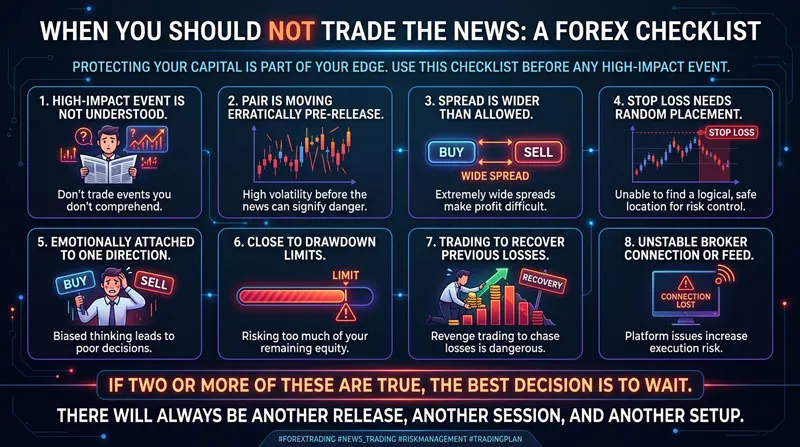
    The professional skill in news trading in forex is not only knowing how to enter. It is knowing when the conditions are too poor to justify the trade. Use this checklist before any high-impact event.
    When You Should Not Trade the News

    • The calendar event is high impact, but you do not understand why it matters.
    • The pair is already moving erratically before the release.
    • The spread is wider than your plan allows.
    • Your stop loss would need to be placed at a random level.
    • You are already emotionally attached to one direction.
    • You are close to your daily or total drawdown limit.
    • You need this one trade to recover previous losses.
    • Your broker connection, platform, or data feed is unstable.

    If two or more of these are true, waiting is usually the better decision. There will always be another release, another session, and another setup. Protecting your account is part of the edge.

    How PropLynq Handles News Trading

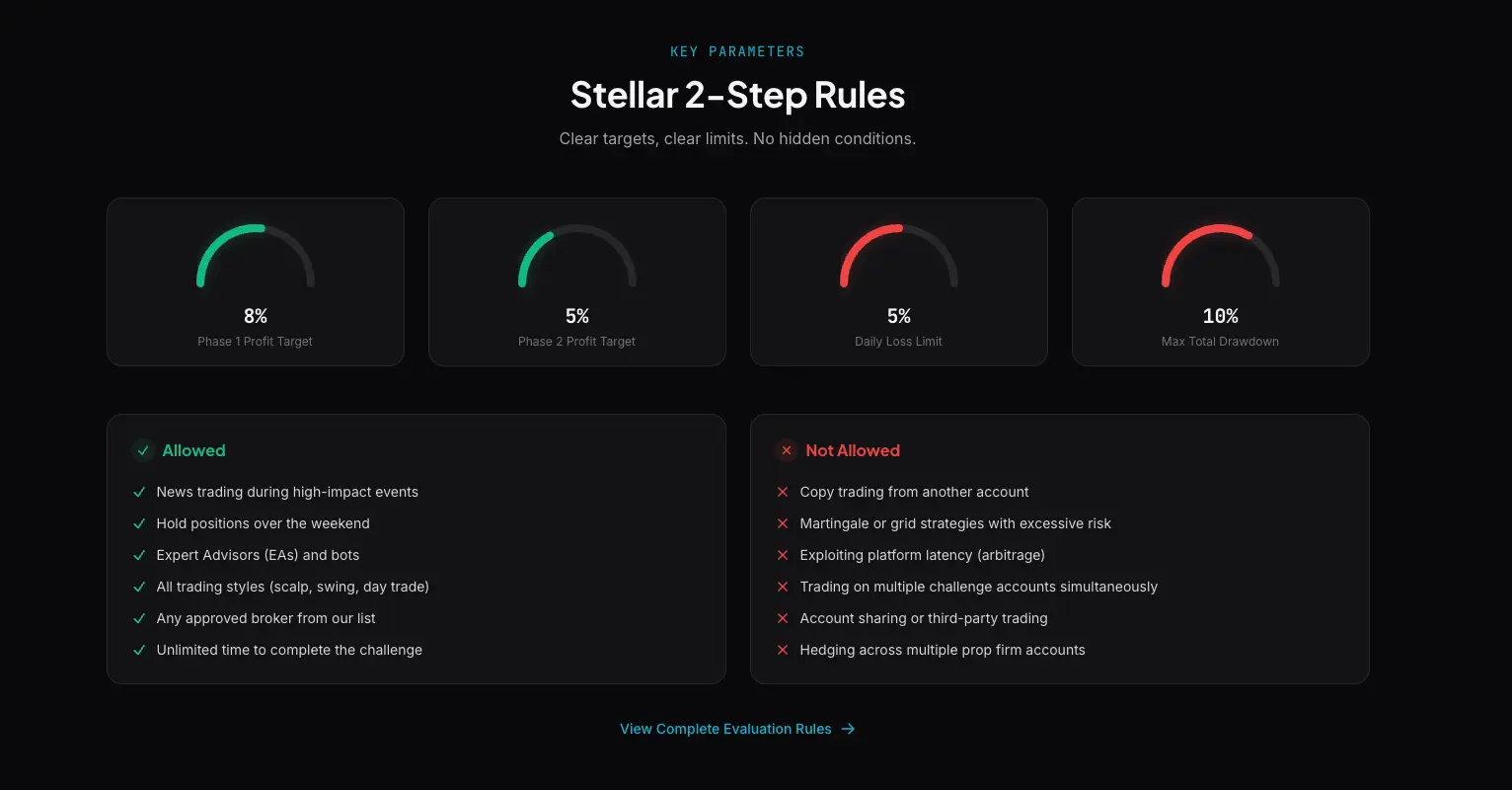
    For news trading in forex, PropLynq’s published rules state that news trading is allowed on Stellar 2-Step accounts and that traders can open and close trades before, during, and after high-impact events such as FOMC, NFP, and CPI. The rules also warn that spreads can widen significantly during news and that slippage is a normal part of news trading.

    That distinction matters. Permission to trade news does not mean the market becomes safer. It means the trader is responsible for building a plan that fits the account rules. PropLynq also lists fair-play restrictions such as latency arbitrage, cross-firm hedging, account sharing, tick scalping, and strategies that depend on guaranteed fills during extreme volatility gaps.

    The practical takeaway is that news trading in forex can fit a PropLynq-style funded environment only when the strategy is rule-aware. The trade should make sense after you account for drawdown, spread, slippage, position size, and the possibility of a fast reversal.

    Final Thoughts on News Trading in Forex

    News can create some of the cleanest movement of the week, but it can also expose every weak part of a trader’s process. If your plan depends on perfect fills, instant reaction time, oversized positions, or hope that the first candle keeps running, the risk is probably too high.

    A better approach is to treat news trading in forex as a structured volatility strategy. Know the event, know the expectation, wait for the market to reveal its reaction, and only trade when the risk still fits your account. The goal is not to catch every news move. The goal is to survive the messy ones and participate only when the opportunity is clear enough to deserve risk.

  • Pending Orders in Forex: Buy Limit, Sell Limit, Buy Stop, and Sell Stop Explained

    Pending Orders in Forex: Buy Limit, Sell Limit, Buy Stop, and Sell Stop Explained

    Pending orders are instructions to open a trade later, only if price reaches a specific level you choose in advance. Instead of entering immediately at the current market price, you set the order and let the platform execute it if the market moves into your planned zone.

    That is why understanding the types of pending orders matters. A trader who knows only market execution may chase entries, react late, or enter before confirmation. A trader who understands pending orders can plan pullback entries, breakout entries, stop-loss placement, and risk before the trade is live.

    In forex, the main pending order types are buy limit, sell limit, buy stop, and sell stop. Some platforms also offer stop limit orders, but the four core order types are enough for most day traders, swing traders, and funded-account traders. The key is not memorizing the names. The key is knowing when each order makes sense and when it can create avoidable risk, especially when you’re trading on PropLynq funded accounts!

    What Is a Pending Order in Forex?

    A pending order in forex is a trade order that waits in the trading platform until the market reaches the price condition you set. If that condition is met, the order becomes an active trade. If price never reaches that level, the order does not open unless you manually adjust it, cancel it, or let it expire.

    This makes pending orders different from market orders. A market order enters immediately at the best available price. A pending order delays execution until price reaches a planned level. That delay can be useful because it forces the trader to define the setup before the emotion of live execution begins.

    Pending orders are commonly used for two broad ideas: trading a pullback or trading a breakout. A pullback trader wants price to move back into a better entry area. A breakout trader wants price to prove momentum by passing through a key level first. The order type changes depending on whether the trader wants to buy or sell, and whether the entry is above or below current price.

    For funded traders, this distinction is more than technical. On a challenge account, a poorly placed entry can affect drawdown, stop distance, and daily loss exposure. PropLynq’s evaluation rules state that drawdown checks include floating and realized P&L, so open trades can matter before they are closed. That makes entry planning especially important for traders using pending orders inside a rules-based account.

    The Four Main Types of Pending Orders

    The four main types of pending orders are buy limit, sell limit, buy stop, and sell stop. Each one answers three questions: do you want to buy or sell, is your entry above or below current price, and are you trading a pullback or a breakout?

    Pending order type Direction Entry location Typical use
    Buy Limit Buy Below current price Buying a pullback into support or value
    Sell Limit Sell Above current price Selling a rally into resistance or premium
    Buy Stop Buy Above current price Buying after a bullish breakout
    Sell Stop Sell Below current price Selling after a bearish breakdown

    A simple way to remember the difference is this: limit orders usually expect price to come back to you, while stop orders usually expect price to continue after breaking a level. Limit orders are often associated with better price. Stop orders are often associated with confirmation.

    Buy Limit Order: Buying Below the Current Price

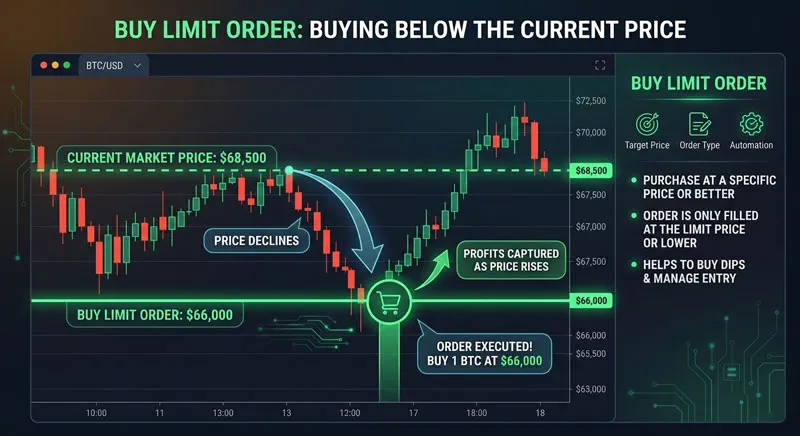
    A buy limit order is used when you want to buy, but only if price drops to a lower level first. You are saying, “I do not want to buy here. I want to buy cheaper, if the market pulls back.”

    For example, imagine EUR/USD is trading at 1.0850, and your analysis shows support near 1.0800. You do not want to chase the current price. You place a buy limit at 1.0800. If price falls to that level, the platform attempts to open a buy trade. If price never reaches 1.0800, the trade does not open.

    Buy Limit Order Buying Below the Current Price

    Buy limits are common around support zones, Fibonacci retracements, moving average pullbacks, and previous breakout levels that may turn into support. They suit traders who want a better entry price and are comfortable entering before the market confirms a fresh move upward.

    The risk is that price may reach your buy limit because the market is genuinely weak, not because it is offering a clean pullback. A buy limit can catch a good dip, but it can also catch a falling market. That is why the stop loss and invalidation level matter more than the entry price itself.

    Sell Limit Order: Selling Above the Current Price

    A sell limit order is the opposite of a buy limit. It is used when you want to sell, but only if price rises to a higher level first. You are saying, “I do not want to sell here. I want to sell at a better price if the market rallies into resistance.”

    For example, GBP/USD is trading at 1.2650, and your analysis shows resistance near 1.2700. You place a sell limit at 1.2700. If price rises to that level, the platform attempts to open a sell trade. If price falls away before touching the level, no trade is opened.


    Sell limits are commonly used around resistance, supply zones, retests of broken support, or the upper edge of a range. They fit traders who believe price may temporarily move higher before rejecting and turning lower.

    The danger is similar to the buy limit problem. Price may not reject the level. It may break through and keep moving. A sell limit is not automatically safer because the entry looks “expensive.” If the trend is strong, selling into strength can become a fast drawdown event.

    Buy Stop Order: Buying Above the Current Price

    A buy stop order is used when you want to buy only if price moves above a certain level. You are not trying to buy cheaper. You are waiting for confirmation that the market has broken higher.

    For example, USD/JPY is trading at 154.20, and resistance sits near 154.60. You believe a break above 154.60 could trigger momentum. You place a buy stop at 154.65. If price trades up into that level, the platform attempts to open a buy trade.

    Buy stops are often used for breakout strategies, continuation entries, news-driven momentum setups, and entries above recent highs. They can help traders avoid entering too early when price is still trapped below resistance.

    The trade-off is entry quality. A buy stop gives more confirmation, but usually at a worse price than a buy limit. The trader may also face slippage if price moves quickly through the entry level. That is why a breakout entry should be planned with spread, volatility, and stop distance in mind. For a deeper look at execution risk, the PropLynq guide on slippage in forex is a useful companion topic.

    Sell Stop Order: Selling Below the Current Price

    A sell stop order is used when you want to sell only if price moves below a certain level. You are waiting for the market to break down before entering short.

    For example, AUD/USD is trading at 0.6420, and support sits near 0.6380. You believe a break below support could lead to downside continuation. You place a sell stop at 0.6375. If price reaches that level, the platform attempts to open a sell trade.

    Sell stops are common below range lows, below trendline breaks, below recent swing lows, or under support zones where sellers may gain control. Like buy stops, they are confirmation-based orders rather than pullback-based orders.

    The main risk is a false breakdown. Price may trigger the sell stop, push slightly lower, and then reverse back into the range. This is why many traders add filters such as session timing, candle close confirmation, spread limits, or volatility checks before using stop entries.

    Limit Orders vs Stop Orders: The Practical Difference

    Limit and stop orders solve different trading problems. A limit order focuses on price improvement. A stop order focuses on confirmation. Neither is automatically better. The best choice depends on the setup.

    Feature Limit orders Stop orders
    Main idea Enter on a pullback Enter after a breakout
    Entry quality Usually better price Usually later price
    Confirmation Less confirmation before entry More confirmation before entry
    Common risk Catching a market that keeps moving against the order Getting triggered by a false breakout
    Best fit Mean-reversion, support/resistance, pullback trading Breakout, momentum, continuation trading

    If your plan is to buy support, a buy limit may be logical. If your plan is to buy strength after resistance breaks, a buy stop may be logical. If your plan is to sell resistance, a sell limit may fit. If your plan is to sell weakness after support breaks, a sell stop may fit.

    Many mistakes happen when traders use the right order name for the wrong idea. Placing a buy stop above resistance is not the same as placing a buy limit at support. One is paying for confirmation. The other is trying to enter before confirmation at a better price.

    How to Choose the Right Pending Order

    The simplest way to choose between the types of pending orders is to start with the trade idea, not the order menu. Ask what the setup requires from price before you want to be involved.

    • Use a buy limit if your plan is to buy a pullback below current price.
    • Use a sell limit if your plan is to sell a rally above current price.
    • Use a buy stop if your plan is to buy after price breaks above a level.
    • Use a sell stop if your plan is to sell after price breaks below a level.

    Then check the practical details. Where will the stop loss go? Is the distance too wide for your risk per trade? Is the spread normal? Is a major news event about to release? Is the pair liquid during the current session? These checks matter because a technically correct pending order can still be a poor trade if the execution environment is bad.

    Currency pair selection matters too. Major pairs often have tighter spreads and better liquidity than exotic pairs, but each pair behaves differently by session and news cycle. Traders who are still choosing their core markets may want to read PropLynq’s guide to major forex currency pairs before building a pending-order strategy around a pair they barely know.

    Common Pending Order Mistakes

    The first common mistake is placing a pending order at an obvious level without thinking about liquidity. Many traders place buy stops just above the same high or sell stops just below the same low. Sometimes that works. Other times the level gets swept, triggers orders, and reverses. A level being obvious does not make it reliable.

    The second mistake is forgetting to attach a stop loss. A pending order is not a full trading plan by itself. It only defines the entry. Without a stop loss, position size, and invalidation point, the order is incomplete.

    The third mistake is using pending orders to avoid responsibility. Some traders place several orders around the market and hope one works. That is not planning. That is spreading emotional risk across multiple tickets. If the trader cannot explain why an order belongs at a specific level, it should not be there.

    The fourth mistake is ignoring expiration. A setup that looked valid during the London session may no longer be valid hours later. If structure changes, the pending order may become stale. Many traders use expiration settings or manual reviews to prevent old orders from triggering in a new context.

    The fifth mistake is using stop entries during fast news without accounting for slippage. PropLynq allows news trading in its listed challenge rules, but traders still remain responsible for the execution and risk consequences of their own entries. That distinction is important: permission to trade does not remove market risk.

    Pending Orders in a Funded Trading Account

    Pending orders can be useful in a funded trading account because they create structure. They force the trader to decide the entry level, stop distance, risk amount, and trade idea before execution. That can reduce impulsive clicking, especially during volatile sessions.

    However, funded-account traders should treat pending orders carefully because risk rules still apply once the trade is active. On PropLynq, the trading accounts page lists challenge models with defined profit targets, daily loss limits, maximum drawdown limits, minimum trading days, leverage, and unlimited time depending on the account type. That means the order is only one part of the decision. The account rule environment matters too.

    For example, a breakout trader using buy stops may need to account for wider spread and faster movement around the entry. A pullback trader using buy limits may need to avoid stacking several limit orders that increase total exposure if price keeps falling. A swing trader using sell limits or sell stops may need to think about weekend gaps, swap, and open-position risk.

    This is why a pending order should be sized from the stop loss, not from confidence. The better question is not “How sure am I?” The better question is “If this order triggers and fails, does the loss still fit the account rules?” Traders comparing rule structures can review the current PropLynq trading accounts page before choosing which account model best matches their execution style.

    Pending Order Checklist Before You Place the Trade

    Before placing any of the types of pending orders, run a quick checklist. It does not need to be complicated. It only needs to catch the mistakes that usually create unnecessary losses.

    • Is the order type correct for the idea: pullback or breakout?
    • Is the entry level based on structure, not hope?
    • Have you already defined the stop loss?
    • Does the position size fit your maximum risk per trade?
    • Is the spread acceptable for the pair and session?
    • Is high-impact news likely to affect execution?
    • Will the order still make sense if it triggers later?
    • Should the order have an expiration time?
    • Does the worst-case loss fit your account rules?

    If one of these answers is unclear, the order probably needs more work. Pending orders are powerful because they automate execution, but they do not automate judgment.

    Final Thoughts on the Types of Pending Orders

    The four main types of pending orders are easy to name but harder to use well. A buy limit buys below current price. A sell limit sells above current price. A buy stop buys above current price after a breakout. A sell stop sells below current price after a breakdown.

    The real skill is matching the order type to the strategy. Limit orders suit traders who want better prices on pullbacks. Stop orders suit traders who want confirmation through a level. Both can work, and both can fail when used without risk planning.

    For funded traders, the cleanest approach is to treat every pending order as a complete trade plan: entry, invalidation, position size, execution risk, and account-rule impact. If the order cannot survive that review, it does not belong in the market yet. If it can, a pending order can turn a reactive idea into a structured trade.

  • What Is Slippage in Forex? A Complete 2026 Guide to Slippage

    What Is Slippage in Forex? A Complete 2026 Guide to Slippage

    What is slippage in forex? It is the gap between the price you expected and the price where your order actually gets filled. That sounds small until you realize a few pips of slippage can quietly change your stop size, reduce your reward-to-risk ratio, or push a funded account closer to a rule breach.

    Most traders first ask what is slippage in forex after a fast entry, a messy stop-loss fill, or a news candle that prints through their level before the platform catches up. The confusion gets worse because slippage is often mixed up with spreads, latency, and requotes, even though those are not the same thing.

    This article breaks the topic down in plain English: what slippage is, why it happens, when it becomes dangerous, and how it differs from a requote. It also explains why execution quality matters even more when you trade inside drawdown rules or a prop-style evaluation.

    What is slippage in forex? The short answer

    If you want the cleanest definition of what is slippage in forex, it is this: your order is executed at a different price from the one you clicked or expected. Sometimes the difference is worse for you. Sometimes it is better. Both are still slippage.

    Imagine you want to buy EUR/USD at 1.0850. You send a market order, but by the time the order reaches the market, the best available ask is 1.0852. Your trade fills two pips higher. That is negative slippage on a buy order. If the fill arrives at 1.0848 instead, that is positive slippage.

    The key point is that slippage is an execution outcome, not a chart pattern and not automatically broker manipulation. It usually appears when price changes faster than your order can be matched at the original level, especially during volatility spikes or thinner liquidity.

    Why execution prices move

    To answer what is slippage in forex properly, you have to look at how orders are actually filled. The market is moving while your order travels from platform to broker or liquidity provider. If the quoted price is gone when execution happens, the fill moves to the next available price.

    Volatility and news speed

    The most obvious cause is fast price movement. Around central bank decisions, CPI, NFP, or surprise headlines, prices can jump through several levels in fractions of a second. In those conditions, your stop-loss or market entry may still execute, but not at the exact price you saw before clicking.

    This is also why slippage gets more attention around scheduled events. On PropLynq’s public rules pages, news trading is allowed, but the firm also warns that spreads can widen significantly during news and that slippage is a normal part of news trading. That matters because the freedom to trade news does not remove execution risk.

    Liquidity and session changes

    Slippage is not only a news problem. It can appear any time liquidity thins out. Session transitions, market open conditions, rollover periods, holiday trading, and lower-volume pairs can all make fills less precise. A trader who has not yet matched pair selection to active market hours will often notice this more. That is one reason it helps to focus on liquid instruments and understand how the major forex pairs behave across sessions.

    Order type and execution path

    Market orders accept the best available price, so they are naturally more exposed to slippage than a limit order that demands a specific price. That does not make limit orders “better” in every case. It simply means they solve a different problem: price control instead of guaranteed execution.

    Your broker model, routing, internet stability, and platform speed also matter. A slower chain gives the market more time to move before the order is confirmed. That is why traders who ask what is slippage in forex are often really asking a bigger question: how much friction sits between my click and my fill?

    Requotes vs changed fills: what is the difference?

    Many traders learn what is slippage in forex, then immediately confuse it with a requote. The difference is simple once you separate execution from confirmation.

    Factor Slippage Requote
    What happens Your order is filled at a different price from the one requested. The original price is no longer available, and a new price is offered.
    Execution status The trade executes automatically at the next available price. The trade pauses until you accept or reject the new quote.
    Trader control Less immediate control once the market order is sent. You can decide whether to take the revised price.
    Typical trigger Fast movement, low liquidity, gaps, or queue changes. Fast movement where the broker cannot or will not honor the requested price.
    Main risk You get a worse fill than planned, or occasionally a better one. You miss the trade, hesitate, or enter late at a new price.

    So if your order goes through at a different level, that is slippage. If the platform comes back and asks whether you want a new price, that is a requote. In practice, both tend to show up in fast conditions, which is why they feel related. But mechanically they are not the same event.

    A useful way to think about it is this: slippage changes your fill, while a requote changes your decision. Slippage says, “you are in, but not exactly where you expected.” A requote says, “the original price is gone; do you still want the trade?”

    A real forex example: changed fills and requotes on the same setup

    A practical way to understand what is slippage in forex is to compare two traders trying to buy the same breakout on GBP/USD during a high-impact release.

    Trader A uses market execution. Price explodes through resistance, and the order is filled three pips above the click price. The setup is live, but the stop is now effectively tighter relative to the actual entry. That trader experienced slippage.

    Trader B is shown a message that the requested price is no longer available and receives a revised quote. Now the trader must choose whether to accept a worse entry or cancel the order. That trader experienced a requote.

    Neither outcome is pleasant if the trade was planned tightly. But the consequences differ. Trader A is already exposed with a changed fill. Trader B still has a decision, but may now chase, hesitate, or miss the cleanest part of the move. This is why execution planning matters just as much as directional bias.

    When execution risk hurts funded traders most

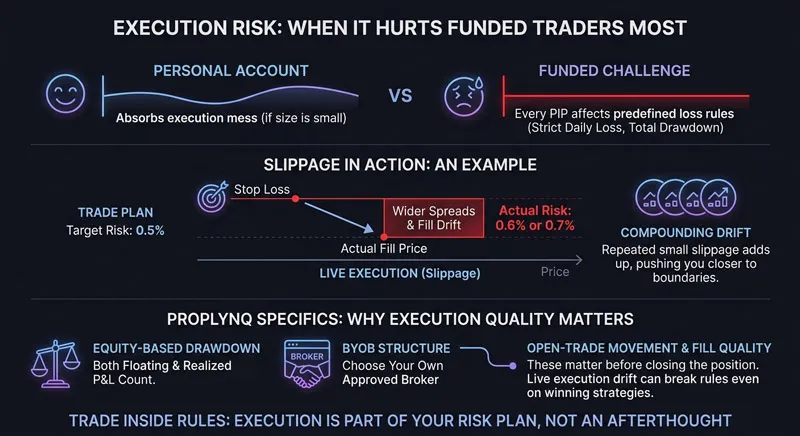
    What is slippage in forex matters more when your account has strict daily loss and total drawdown rules. A personal account can absorb some execution mess if your size is small enough. A funded challenge is less forgiving because every pip affects a predefined loss boundary.

    What traders misunderstand about slippage in forex

    For example, a stop intended to risk 0.5% can become 0.6% or 0.7% once spreads widen and the fill slips through the level. That may not sound dramatic, but repeated execution drift adds up. Traders often blame strategy failure when the real issue is that their live fills are worse than their backtest assumptions.

    If you trade inside prop rules, execution quality should be part of your risk plan, not an afterthought. That is especially true if you are already managing tight loss limits, which is why it helps to understand how drawdown structures change trading pressure and to review how disciplined challenge execution works in practice.

    PropLynq’s public materials make this especially relevant because the firm states that challenge drawdown is equity-based, both floating and realized P&L count, and approved-broker trading happens under a BYOB structure. In plain terms, open-trade movement and fill quality can matter before you ever close the position. If you are comparing firms or models, review the live trading account structures and the funded-trader process before assuming your strategy will behave the same way under evaluation rules.

    How to protect your fills without overcomplicating your trading

    If you are asking what is slippage in forex because you want to avoid it completely, the honest answer is that you usually cannot remove it entirely. You can only reduce it, plan for it, and stop pretending your fills will always be perfect.

    • Trade more liquid pairs when possible, especially if you are still building consistency.
    • Avoid impulsive market orders during major data releases unless news execution is part of your actual edge.
    • Use limit orders when price precision matters more than guaranteed entry.
    • Reduce position size in fast conditions so a bad fill does not distort your risk plan.
    • Check your broker connection, VPS setup, and execution history instead of blaming every bad fill on the market.
    • Track live slippage in your journal. If your backtest assumes perfect fills, your numbers are incomplete.

    The goal is not to trade scared. The goal is to stop sizing and planning as if friction does not exist. Traders who ignore execution costs often think they need a better strategy when they really need better assumptions. That is the practical side of what is slippage in forex: execution reality has to be part of your model, not an excuse you invent after the trade.

    What traders misunderstand about slippage in forex

    One reason what is slippage in forex gets misunderstood is that traders usually notice only the painful side of it. A few common mistakes keep the confusion alive.

    Mistake one: assuming slippage is always negative. It is not. Positive slippage exists too, even if traders remember the bad fills more clearly. When traders search what is slippage in forex, they usually mean the painful version, but the definition includes favorable fills as well.

    Mistake two: confusing slippage with spread. Spread is the bid-ask difference before execution. Slippage is the difference between expected and actual execution price.

    Mistake three: blaming every slippage event on broker abuse. Bad execution can come from poor infrastructure, but it can also come from normal market behavior during fast or thin conditions.

    Mistake four: using very tight stops on volatile pairs and acting surprised when live fills look worse than simulation. Tight planning and real-world execution are not always compatible.

    Mistake five: treating requotes as the same thing. They are cousins, not twins. Slippage changes the fill. A requote changes the quote.

    Final takeaway: execution is part of risk

    So, what is slippage in forex? It is the difference between the price you expected and the price you actually receive when the market executes your order. It can be positive or negative, but it always reflects one reality: trading happens in a moving market, not on a frozen screenshot.

    The difference between slippage and a requote is just as important. Slippage means the trade fills at a changed price. A requote means the original price is unavailable and you are offered a new one. Once you understand that difference, execution behavior becomes easier to diagnose.

    For most traders, the practical lesson is simple. Choose liquid conditions, plan around volatility, and size your trades as if fills will sometimes be imperfect. If you trade under challenge rules or funded-account limits, build that assumption into your process from day one. That is where what is slippage in forex stops being a glossary term and starts becoming a real risk-management skill.

  • Top 7 Major Forex Currency Pairs to trade

    Top 7 Major Forex Currency Pairs to trade

    The short answer is this: the top 7 major forex currency pairs are the U.S. dollar, euro, Japanese yen, British pound, Swiss franc, Canadian dollar, Australian dollar, and often the New Zealand dollar. The best one to trade is not “the strongest” currency. It is the pair whose volatility, session timing, spread behavior, and news flow fit the way you actually trade. For most beginners, that usually means starting with EUR/USD, then looking at USD/JPY only after they understand how each pair moves.

    That distinction matters because traders often ask what are the major currency pairs in forex which one to trade as if there is one universal winner. There is not. One trader needs calm pricing and tight spreads. Another needs more movement during London or New York. Another only trades Asian hours and naturally finds more relevance in yen pairs. The right choice is about fit, not hype.

    What are the 7 major forex currency pairs?

    When traders talk about the forex majors, they usually mean the currencies that sit behind the most widely traded and most liquid pairs. In retail trading, that conversation almost always starts with USD, EUR, JPY, GBP, CHF, CAD, AUD, and NZD. The classic “major pairs” are then built around the U.S. dollar:

    • EUR/USD
    • USD/JPY
    • GBP/USD
    • USD/CHF
    • USD/CAD
    • AUD/USD
    • NZD/USD

    There is a useful nuance here. In retail education, the majors are still usually framed as those classic USD pairs. But global market data can shift the ranking of what is most actively traded at a given time. That is why it helps to separate the retail label “major pairs” from the institutional question “which pairs are currently seeing the most turnover?”

    Major forex pairs traders usually start with

    Not every major currency behaves the same way. Some pairs are smoother. Some are faster. Some react heavily to rate expectations and macro headlines. Some move best during very specific sessions. If you are trying to decide what are the major forex currency pairs, which one to trade, this is the part that matters most.

    Pair What it is known for Best fit tendency Main caution
    EUR/USD Deep liquidity, tight spreads, broad analyst coverage Beginners, structured intraday traders, macro traders Can still whipsaw around major data
    USD/JPY Strong reaction to yields, BoJ policy, risk sentiment Session-aware traders, news and momentum traders Can move sharply on policy headlines
    GBP/USD Higher average movement than EUR/USD Experienced day traders who can handle more volatility More violent intraday swings and stop hunts
    USD/CHF Defensive-flow reputation, often tied to risk sentiment Macro traders and correlation-aware traders Can be less intuitive for beginners
    USD/CAD Sensitive to oil and North American data Traders who follow commodities and U.S./Canada releases Oil moves can change the rhythm quickly
    AUD/USD China-linked sentiment, commodity sensitivity, Asia-Pacific relevance Swing traders and traders active in Asia/London overlap Can be headline-sensitive around China risk
    NZD/USD Clean trending stretches at times, smaller global focus Selective swing traders Usually wider spreads and thinner liquidity than EUR/USD

    You are not choosing a flag. You are choosing market behavior. That is why a trader can understand the list of majors perfectly and still choose the wrong pair for their schedule or psychology.

    Which Forex major currency pair is best to trade?

    For most newer traders, EUR/USD is usually the best first choice. It is widely followed, heavily quoted, and easier to study because there is constant institutional research, predictable event coverage, and usually tighter transaction costs than more volatile alternatives. That does not mean EUR/USD is always easy. It means the market is easier to observe, compare, and review.

    USD/JPY is often the next logical candidate. It can be very clean when rate expectations and risk sentiment line up, but it can also jump fast on Bank of Japan language, Treasury yield moves, or intervention fears. Traders who are active during Asian hours or who like momentum often keep it high on their list because the pair can show intention more clearly than slower markets.

    GBP/USD is one of the major forex currency pairs that many beginners are tempted to trade too early. It offers bigger movement, and bigger movement looks attractive. But bigger movement also means sloppier entries get punished faster. If your risk model is not stable yet, learning how to pass a prop firm challenge with controlled execution usually matters more than chasing the fastest chart on your platform.

    AUD/USD and USD/CAD can be excellent once you understand what drives them. AUD/USD often matters more when China-linked growth sentiment, commodities, and risk appetite are in focus. USD/CAD matters more when oil and North American macro releases are driving flows. Those pairs are not worse. They just reward traders who understand their context instead of trading them as generic alternatives to EUR/USD.

    A practical answer by trader type

    • Beginner: Start with EUR/USD.
    • Momentum trader: Add USD/JPY once you can track rates and session timing.
    • Higher-volatility intraday trader: Consider GBP/USD, but only with tighter discipline.
    • Commodity-aware trader: Look at AUD/USD or USD/CAD.
    • Asia-session trader: USD/JPY and AUD/USD usually deserve more attention than GBP/USD.

    When each pair tends to make the most sense

    One of the easiest ways to pick the wrong market is to ignore session fit. Traders often build a watchlist based on popularity, then wonder why the pair feels slow, messy, or too expensive when they open the chart. A better approach is to ask when the pair is naturally most active and whether that lines up with your own routine.

    Which Forex major currency pair is best to trade

    EUR/USD usually gets the most attention during London and the London–New York overlap. That is one reason it is such a common learning pair: the market is heavily watched, the flow is deep, and the structure is easier to review after the fact. Building a repeatable TradingView workflow helps here because session behavior becomes clearer when you review the same pair the same way each day. USD/JPY can stay relevant across more than one major session, but it becomes especially important when Japanese policy headlines, U.S. yields, or broad risk sentiment are in focus.

    GBP/USD often rewards traders who are present for London trading and who can react to faster bursts of momentum. AUD/USD and NZD/USD can make more sense for traders who monitor Asia-Pacific hours or who build swing ideas around broader risk tone. USD/CAD becomes much more interesting when oil and North American releases are clearly shaping price.

    That is why the best watchlist is usually smaller than traders think. You do not need all the major forex currency pairs on screen at once. You need the two or three pairs that match your session, your strategy, and your ability to prepare properly.

    Scenario examples: the same trader can need different pairs

    Imagine two traders asking the same question about what to trade. Trader A is available during London open, prefers cleaner structure, and is still learning how macro releases affect price. Trader B lives in a time zone where Asian market hours are easier to follow and prefers breakout-style movement.

    Trader A probably gets more value from EUR/USD first. The pair gives enough movement to matter, but usually not so much noise that every mistake becomes chaos. It is easier to build a review process around it because news, analyst commentary, and technical reaction points are heavily covered.

    Trader B may naturally connect better with USD/JPY or AUD/USD. That does not mean those pairs are objectively better. It means they align with the trader’s available hours and the type of flow they can realistically observe in real time.

    Now imagine a third trader who already has solid execution but wants bigger intraday range. That person may do fine on GBP/USD. The same pair that hurts a beginner can work well for someone who already knows how to manage pace, size, and stop placement. The market did not change. The fit changed.

    What people get wrong about major forex currency pairs

    The biggest mistake is assuming that the “best” pair is the one that moves the most. More movement can help a good setup reach target faster, but it can also make weak entries, oversized positions, and emotional decisions much more expensive.

    The second mistake is thinking the retail list of major forex currency pairs is the same as the list of pairs you personally should trade. Market popularity and personal fit are different questions. A pair can be globally important and still be a poor match for your schedule, your psychology, or your risk tolerance.

    The third mistake is ignoring execution cost. In rule-based trading, a pair with lower friction is often more forgiving for repetition and review than a pair that looks exciting but quietly eats edge through spreads, slippage, and impulsive re-entry.

    There is also a more current market nuance worth understanding. The retail label “majors” still points to the classic seven USD pairs, but global turnover data can tell a more dynamic story. That does not suddenly rewrite beginner pair selection. It simply reminds traders that category labels and real-world flow leadership are not always identical.

    How to choose the right pair for your strategy

    If you want a simple framework for what are the major forex currency pairs, which one to trade, use this checklist before you commit to a watchlist.

    • Do I trade during the pair’s active session, or am I forcing trades when liquidity is thinner?
    • Can I handle the pair’s normal intraday range without widening stops randomly?
    • Do I understand the main drivers: rates, risk sentiment, commodities, central bank language, or regional data?
    • Are the spreads and execution conditions suitable for my timeframe?
    • Does this pair match my method, or am I choosing it because social media says it moves?
    • Can I review this pair consistently enough to learn its rhythm?

    If you answer “no” to most of those questions, the pair is probably wrong for you right now. That is not a permanent judgment. It is just a watchlist decision. Most traders improve faster by getting deeply familiar with one or two majors than by jumping between six pairs every week. That is also why your market choice should line up with your broader method, especially if you are comparing the best trading styles for prop challenges and trying to figure out which type of execution really suits you.

    How this choice matters for funded traders and prop-style rules

    Pair selection becomes even more important when you are trading inside evaluation rules or a funded-account model. A fast pair with wider intraday swings can feel exciting on a personal account, but the same behavior can be much harder to manage when daily loss and maximum drawdown rules are fixed. That is one reason traders comparing a funded trading account should not stop at headline account size.

    It also helps to connect pair choice to account structure. Before committing, it makes sense to compare funded account models and see whether your preferred major forex currency pairs and holding style fit the drawdown rules, profit targets, and pace the account expects. If your style depends on faster movement, wider stops, or holding through normal noise, account structure matters just as much as pair choice.

    A good rule for the first three months is simple: master one pair, understand a second, and ignore the rest unless your data proves they add value. Most watchlists are too wide long before the trader has earned that complexity. Repetition is usually a bigger edge than variety.

    Final answer: which one of the major forex currency pairs to trade?

    The major forex currency pairs are usually USD, EUR, JPY, GBP, CHF, CAD, AUD, and NZD, and the classic major pairs are the seven USD-based pairs built from them. If you want one practical answer on which to trade first, start with EUR/USD. Add USD/JPY next if you understand session timing and rate sensitivity. Move to GBP/USD only when your execution is already disciplined enough to handle faster swings.

    Do not choose a major pair because it is famous. Choose it because its volatility, cost, news rhythm, and trading session match your method. That is the real answer most traders skip when they rush into the wrong market.

  • Static vs Trailing Drawdown: What Funded Traders Need to Know

    Static vs Trailing Drawdown: What Funded Traders Need to Know

    Most traders do not fail a funded challenge because they picked the wrong profit target. They fail because they misunderstood the rule that decides when the account is done. That is why static vs trailing drawdown matters more than many beginners realize. Two firms can advertise similar percentages, but the actual pressure on your trading can feel completely different once open profit, floating loss, and new equity highs start changing the room you have left. Static drawdown stays fixed. Trailing drawdown moves as the account reaches new peaks, and that changes how aggressively you can press trades or how much profit you can afford to give back. The confusion around static vs trailing drawdown is not academic. It affects position sizing, trade management, and whether a strategy that looks fine on paper is actually survivable inside a challenge.

    Static vs trailing drawdown: the short answer

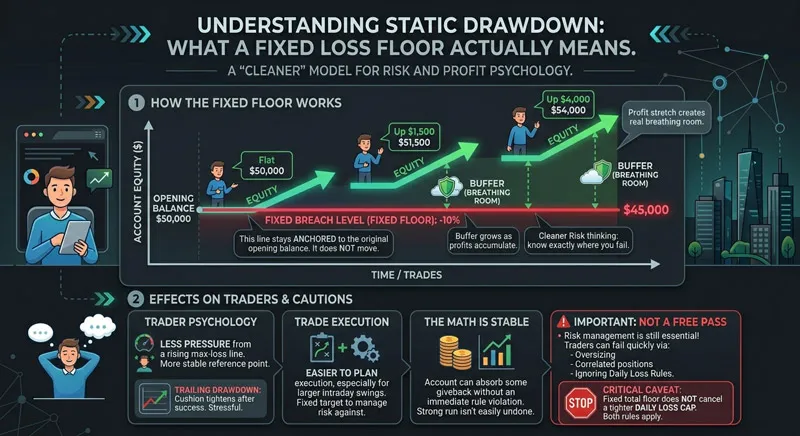
    Static drawdown is a fixed loss floor, usually anchored to the starting balance. If the account is allowed a $5,000 maximum drawdown on a $50,000 account, that breach line stays in the same place unless the firm’s rules say otherwise. Trailing drawdown is different. The loss floor moves up as the account reaches new balance or equity highs, which means your room can shrink even while you are making progress.

    That is the real answer to static vs trailing drawdown: static gives you a stable floor to work above, while trailing keeps ratcheting the floor upward as you perform. Static often feels easier to manage for traders who need normal price movement and some profit giveback. Trailing can reward discipline, but it can also punish loose trade management, especially when the rule is tied to equity rather than closed balance. Not every trailing rule works the same way, so the exact wording matters.

    What a fixed loss floor actually means

    Static drawdown is the simpler structure to understand because the breach level does not chase your profits. The firm sets a maximum total loss from the opening balance, and that floor stays fixed. On a $50,000 account with a 10% static max drawdown, the key line is $45,000. Whether you are flat, up $1,500, or up $4,000, the rule is still anchored to that original threshold. That gives traders a cleaner way to think about risk: the buffer between current equity and the fixed floor grows as profits accumulate.

    That does not mean static drawdown is loose or forgiving in every situation. A trader can still fail quickly by oversizing, stacking correlated positions, or ignoring daily loss rules. But static does remove one source of pressure that trailing models create: you are not watching the maximum-loss line rise every time the account makes a new high. For many traders, especially those who hold for larger intraday swings or allow trades time to develop, that fixed reference point makes execution easier to plan.

    What a fixed loss floor actually means

    It also changes the psychology of profit. Under a static structure, a winning stretch usually creates more real breathing room instead of simply dragging the breach line upward behind you. That is why traders often describe static vs trailing drawdown as a choice between a cushion that grows and a cushion that can tighten after success. The math is more stable, and the account can absorb some giveback without turning a strong run into an immediate rules problem. The catch is simple: static drawdown still needs to be read alongside the daily loss rule, because a fixed total floor does not cancel a tighter daily cap.

    Why a moving loss floor changes execution

    Trailing drawdown is the rule that catches traders who assume profits automatically create safety. Instead of leaving the loss floor fixed at the starting balance, trailing drawdown pushes that floor upward whenever the account reaches a new high. The basic formula is simple: highest balance or equity reached, minus the allowed drawdown amount. Once that line moves higher, it usually does not come back down after losses. That is why traders often describe trailing drawdown as a moving stop on the whole account rather than on one position.

    The detail that matters most is what the firm is trailing. Some firms trail closed balance only. Others trail real-time equity, which includes floating profit and floating loss. Equity-based trailing is tighter because open profit can lift the high-water mark before the trade is closed. If that trade reverses, the trader may discover that the account is much closer to the breach line than it looked a few minutes earlier.

    That is also why trailing drawdown changes trade management. It rewards consistency, but it can punish traders who let open winners swing too far back, pyramid too aggressively, or assume that unrealized profit is harmless until the position is closed. Under a static structure, early profits usually widen the cushion. Under a trailing structure, early profits can shrink the room left between current equity and the kill switch. In practical terms, static vs trailing drawdown is often a question of how much giveback your method can tolerate. The rule is not automatically bad, but it is less forgiving of sloppy execution and much more sensitive to how the firm defines the calculation.

    • Static drawdown stays anchored to the starting balance.
    • Trailing drawdown ratchets upward when the account hits new highs.
    • Balance-based trailing is usually easier to track than equity-based trailing.
    • Floating P&L can matter before a trade is closed if the rule is equity-based.

    Static vs trailing drawdown comparison table

    A side-by-side view makes the real difference easier to see in static vs trailing drawdown. The headline percentage alone rarely tells the full story. What matters is whether the breach line stays fixed or climbs with performance.

    Feature Static drawdown Trailing drawdown
    Reference point Starting balance Highest balance or equity reached
    Does the loss floor move? No, it stays fixed Yes, it ratchets upward with new highs
    What happens after profits? Your cushion usually grows Your breach line often moves closer
    Tracking difficulty Simpler Higher, especially if equity-based
    Open-trade sensitivity Depends on firm rules, but usually less punishing structurally Can be very sensitive if floating equity is included
    Best fit tendency Traders who need room for normal pullback and trade development Traders who keep risk tight and manage profit giveback aggressively

    The simplest way to read this table is to ask one question: does my strategy need breathing room after I make progress, or can I live with a floor that rises behind me? That answer usually matters more than the marketing language around the account.

    A $50,000 example: same P&L, different drawdown outcome

    Assume two traders each start with a $50,000 account and a $5,000 maximum loss allowance. This is where static vs trailing drawdown becomes expensive. On the static account, the hard floor is $45,000 and it stays there. On the trailing account, the floor starts at $45,000 too, but it moves up whenever the account prints a new high. The traders follow the same path.

    First, both traders make $3,000. Their account reaches $53,000. On the static account, the loss floor is still $45,000, so there is now $8,000 of room between current balance and the breach line. On the trailing account, the floor ratchets up to $48,000 because the allowed loss still trails by $5,000 from the new high. The trader feels ahead, but the usable cushion is smaller than it looks.

    Next, both traders give back $4,500 during a rough stretch. Their account drops to $48,500. The static account is still alive with $3,500 of room left before breach. The trailing account is now only $500 above the line. One more normal pullback, one spread spike, or one stubborn hold can end the challenge.

    Now imagine the trader briefly hits $54,200 in open equity before closing lower. On an equity-based trailing model, that temporary high can pull the floor up again even if the final closed balance does not hold the move. That is the part traders miss. The same P&L path can feel manageable under static drawdown and much tighter under trailing drawdown because the rule itself changes the room available after success.

    Which traders usually fit static vs trailing drawdown?

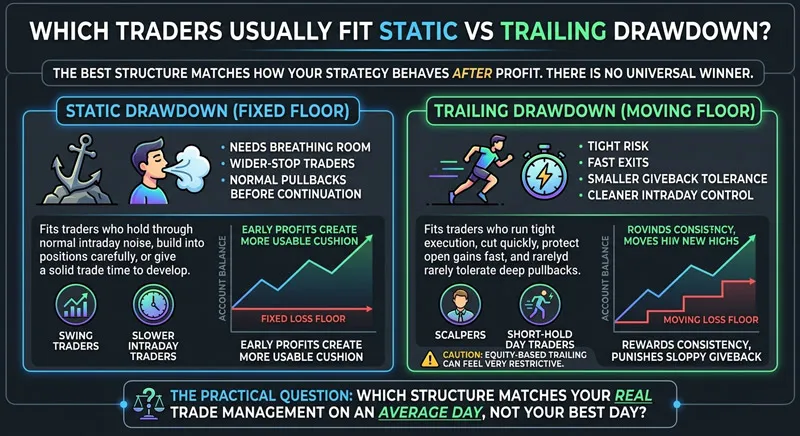
    There is no universal winner in static vs trailing drawdown. The better structure is usually the one that matches how your strategy behaves after it goes into profit. Traders who need positions to breathe often prefer a fixed floor. Traders who cut quickly, protect open gains fast, and rarely tolerate deep pullbacks may be more comfortable with a moving one.

    Which traders usually fit static vs trailing drawdown

    Static drawdown usually fits traders who hold through normal intraday noise, build into positions carefully, or give a solid trade time to develop. Swing traders and slower intraday traders often value the fact that early profits create more usable cushion instead of dragging the account-level loss floor upward. That does not make static easy. It just makes the risk envelope easier to read.

    Trailing drawdown usually fits traders who already run tight execution. Scalpers, short-hold day traders, and traders who actively defend open equity may find it workable because the rule rewards consistency and punishes sloppy giveback. But this is the catch: if your style depends on watching an open winner float, pull back, and then continue, trailing can feel restrictive very quickly, especially when the rule is based on equity rather than closed balance.

    • Static drawdown tends to fit: traders who need breathing room after gains, wider-stop traders, and strategies with normal pullback before continuation.
    • Trailing drawdown tends to fit: traders with tight risk, fast exits, smaller giveback tolerance, and cleaner intraday control.

    The practical question is not which rule sounds easier in marketing. In static vs trailing drawdown, ask which structure matches your real trade management on an average day, not your best day.

    How PropLynq account types map to each rule

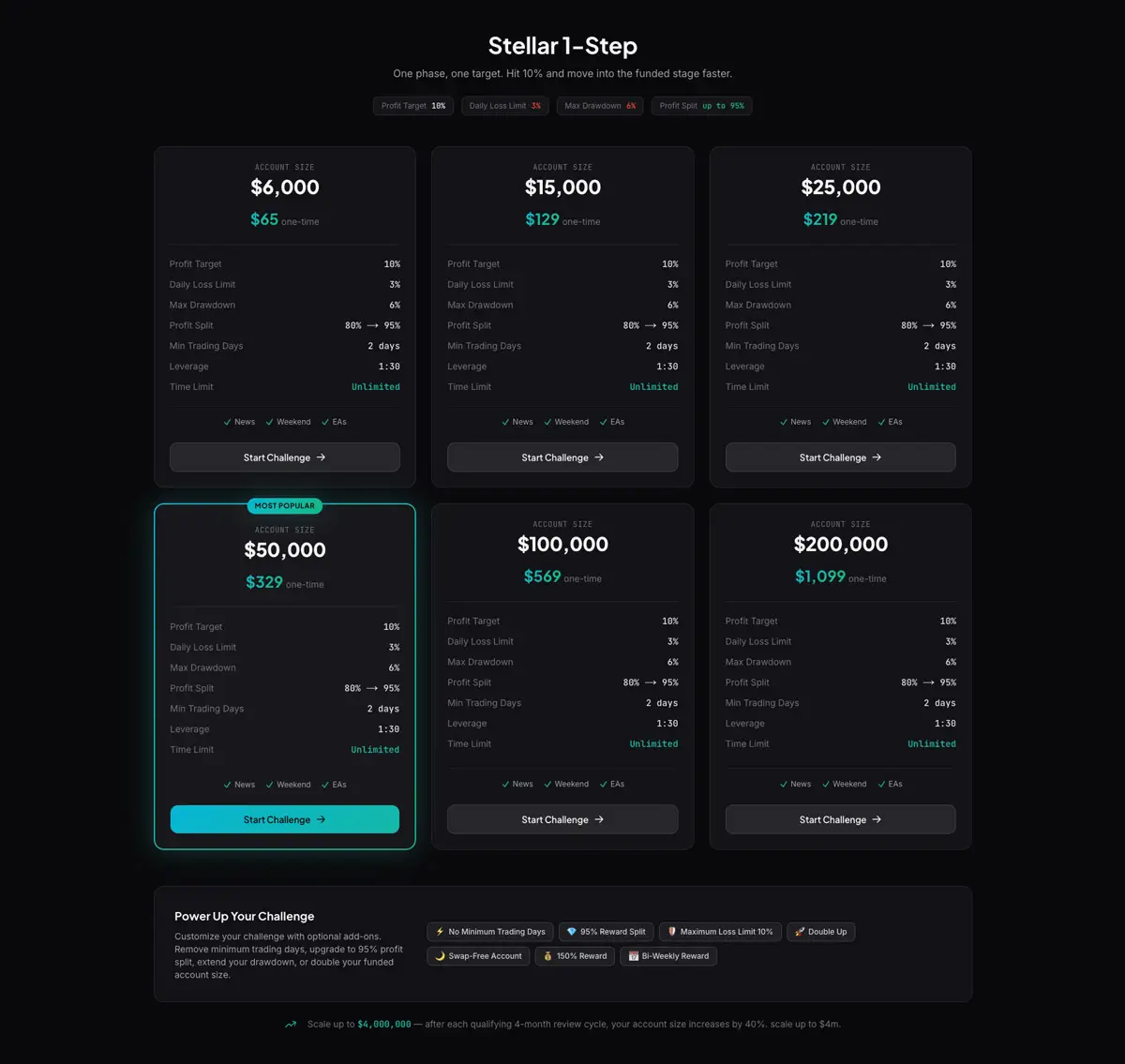
    On PropLynq’s live comparison table, the split is fairly clear. For PropLynq readers, static vs trailing drawdown is visible in the product mix, not just in theory. Stellar 2-Step is listed with a 5% daily loss limit and 10% max drawdown. Stellar 1-Step is listed with a 3% daily loss limit and 6% max drawdown. The same table also shows Stellar Lite at 4% daily loss and 8% max drawdown, while Instant Funding is shown with no daily loss limit and a 6% trail. Inside PropLynq, static vs trailing drawdown is not an abstract distinction. The evaluation-style accounts use fixed maximum-drawdown language, while Instant Funding is the program explicitly labeled as trailing.

    The public published evaluation rules make the fixed-side wording more concrete. PropLynq says total drawdown is calculated from the initial starting balance. It also says daily drawdown is measured from equity at the start of each trading day at 00:00 UTC, and that both floating and realized P&L count. That matters because a trader can have a fixed total drawdown structure while still being monitored with equity-based daily-loss logic.

    For readers comparing account types, the practical move is to compare PropLynq challenge types first, then read the exact rule wording. The plan table tells you which structure you are likely dealing with. The rules page tells you how tightly that structure is enforced in real trading conditions. If you want the full setup and broker-monitoring context, how PropLynq works also confirms the BYOB model, 10+ approved brokers, read-only MT5 investor-password monitoring, and unlimited time across Stellar challenge phases.

    Decision checklist before you buy a funded challenge

    Before you pay for any account, run through this checklist. Most confusion around static vs trailing drawdown comes from traders reading the percentage and skipping the calculation method. If a firm cannot explain this clearly, static vs trailing drawdown is exactly where the hidden friction usually sits.

    • Is the max loss floor fixed from the starting balance, or does it trail behind new highs?
    • Does the firm calculate the rule from balance or equity?
    • Do floating profits and floating losses count before trades are closed?
    • Is there also a separate daily loss rule that can breach the account sooner?
    • If the rule trails, does it stop at breakeven or keep moving under specific conditions?
    • How does the rule fit your real trade style: wider holds, quick scalps, or something in between?
    • What happens after you get funded, and how do payouts work once you are consistent?

    That last point matters more than many traders expect. A challenge is not just about passing. It is about whether the rule set still makes sense after funding. On PropLynq’s live pages, the payout structure is public: the site shows a $50 minimum withdrawal, multiple withdrawal methods, zero fees, and a 24-hour processing guarantee on the payout schedule and methods page.

    If a firm answers these questions clearly, you are dealing with a rules page worth trusting. If the wording stays vague, assume the rule will feel worse in practice than it looks in marketing.

    Final takeaway on static vs trailing drawdown

    The cleanest way to think about static vs trailing drawdown is this: static keeps the loss floor fixed, while trailing keeps moving it upward as the account makes new highs. Neither rule is automatically better. The better rule is the one your strategy can survive without forcing bad trade management.

    For most traders, the safest move is to stop comparing headline percentages and start reading the calculation method. Check whether the rule is based on balance or equity, whether floating P&L counts, and whether the account uses a fixed max-drawdown model or a trail. That is where static vs trailing drawdown becomes a real trading decision instead of a marketing label.

    If you are comparing live account options, start with the rule wording, then confirm the plan structure and payout details before you buy.

  • What is Best Trading Styles for Prop Challenges in 2026

    What is Best Trading Styles for Prop Challenges in 2026

    When beginners search for the Best Trading Styles for Prop, they usually compare the wrong things first. They ask which style is faster, which style can hit targets quicker, or which style looks more exciting on social media. But a prop challenge is not a normal trading environment. It is a rule-based test, and the Best Trading Styles for Prop are rarely the styles that look the most aggressive on paper. They are the styles that create the least friction with drawdown limits, minimum trading days, time pressure, and trader psychology.

    For a beginner, that distinction matters more than most marketing pages admit. Scalping can look efficient because it offers more opportunities and faster feedback. Swing trading can look safer because it slows everything down and reduces decision frequency. But inside a challenge, neither survives just because of its label. The Best Trading Styles for Prop are the styles that match the trader’s routine, execution skill, and emotional control.

    For most beginners, that answer usually points toward slower and cleaner decision-making before it points toward speed. Swing trading or lower-frequency execution is often easier to manage because it reduces the pace of decision-making and gives more room for planning. Scalping can work, but it usually rewards traders who already have a tested intraday process and the discipline to stay precise under pressure. So before choosing a style for prop trading, it is smarter to measure the friction it creates than to chase the version of the Best Trading Styles for Prop that looks most impressive online.

    Best Trading Styles for Prop start with the wrong question

    Most beginners start by asking which style is “best,” but that lens is too abstract for a challenge account. A strategy does not pass because it sounds smart. It passes because it can operate cleanly inside the rules. The Best Trading Styles for Prop are not automatically the ones with the highest theoretical upside. They are the ones that can survive the account structure the trader is actually buying.

    Why the Best Trading Styles for Prop depend on compatibility

    If a trader needs constant action, takes too many impulsive entries, or struggles to stop after a small losing streak, even a valid strategy can break down quickly under daily loss limits. On the other side, a trader may choose swing trading because it seems calmer, then discover that overnight exposure or slow progress toward the target creates a different kind of stress. In both cases, the problem is not the style itself. The problem is the mismatch between the style and the challenge environment.

    That is why generic comparisons often leave readers unsatisfied. They tell you that scalping is fast and swing trading is slower, which is true but incomplete. What they usually fail to explain is how a style behaves once a prop firm adds guardrails. A challenge with a 5% daily loss limit, 10% max drawdown, minimum trading days, and unlimited time changes the decision completely. Suddenly, the Best Trading Styles for Prop are not the ones that feel exciting. They are the ones you can repeat without colliding with those limits.

    Why the Best Trading Styles for Prop are really a friction decision

    A better framing is this: a prop challenge is a pressure test for your decision process. It shows whether your style encourages rushed execution, emotional clustering of losses, or poor trade selection when the target feels far away. Once you view the problem that way, the search for the Best Trading Styles for Prop becomes more practical.

    The first friction is rule friction. This is the pressure created when your natural way of trading runs into the account rules. If your style needs freedom to hold through news or over the weekend, restrictions in those areas matter immediately. If your style produces many small trades, daily drawdown limits matter more. If you are patient and selective, minimum trading days and unlimited-time structures may support you better than a model that pushes for speed.

    The second friction is execution friction. Scalping places much more weight on timing, consistency, and cost sensitivity. Small mistakes matter more when the trade idea itself aims for smaller moves, which is why spread, slippage, and rushed entries become such a big part of the conversation. Swing trading reduces some of that pressure because decisions happen less often and setups usually have more room to develop. But lower frequency does not mean no execution burden. It means the burden shifts from fast reaction to better planning, sizing, and patience.

    The third friction is psychological friction. Some traders cannot tolerate inactivity, so they force scalps just to feel involved and to pass a prop firm challenge as fast as they can. Others cannot tolerate open trades sitting overnight, so they sabotage swing positions early even when the plan is still valid. One trader breaks rules because speed amplifies emotion. Another breaks the plan because waiting feels unbearable. That is why the Best Trading Styles for Prop are rarely the styles that sound most impressive. They are the ones that keep rule friction low, execution demands manageable, and psychological pressure inside the trader’s actual tolerance.

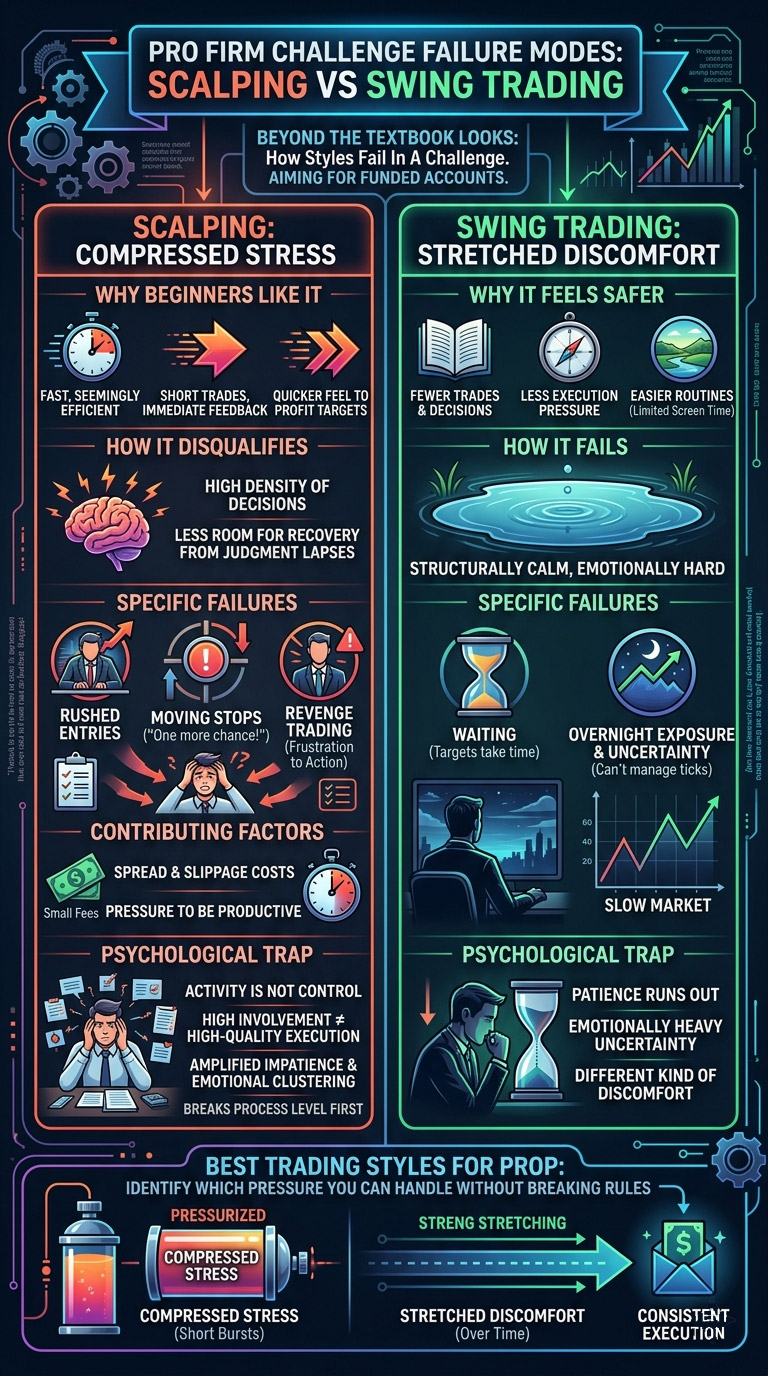
    Best Trading Styles for Prop fail differently in scalping and swing trading

    The surface-level comparison between scalping and swing trading is easy. One is faster, one is slower. One demands more market time, one demands more patience. But the Best Trading Styles for Prop are easier to judge when you look at how each style usually fails inside a challenge, not just how each style looks in a textbook. Getting a funded trading account is more than that.

    Best Trading Styles for Prop fail differently in scalping and swing trading

    Why scalping can disqualify the Best Trading Styles for Prop for beginners

    Scalping attracts beginners for an understandable reason: it looks efficient. The trades are short, the feedback is immediate, and the path to a profit target can feel faster than waiting days for a swing setup to develop. Inside a prop challenge, though, that speed changes the nature of the risk. Scalping does not usually fail because short-term trading is invalid. It fails because the style creates a high density of decisions, and every small lapse in judgment has less room to recover.

    That is what makes scalping so unforgiving for beginners. A setup can be decent, but the entry is rushed. The stop is valid, but it gets moved because the trader wants one more chance. A scratch trade turns into a revenge trade because the pace of scalping leaves almost no time between frustration and action. Add spread, slippage, and the pressure to make the session feel productive, and the style starts punishing the trader before the strategy has even had a fair test.

    There is also a psychological trap hidden inside the appeal of speed. Many beginners mistake activity for control. They feel productive because they are involved in the market constantly, but high involvement is not the same as high-quality execution. A scalper can be busy all session and still end the day with a rule problem, not because the market was impossible, but because the style amplified impatience and emotional clustering. That is why scalping often breaks a beginner at the process level first.

    Why swing trading can make the Best Trading Styles for Prop feel slower but safer

    Swing trading usually creates less execution pressure at the start. Fewer trades mean fewer decisions, more planning time, and less exposure to the small frictions that punish short-term trading. That alone makes swing trading feel more manageable for many beginners. It is also easier to build a routine around. A trader with limited screen time can review higher timeframes, plan levels, and avoid living inside every tick.

    But swing trading has its own failure mode, and it is less obvious. Structurally, the style is calmer. Emotionally, it can be harder than it looks. A beginner may choose swing trading to avoid the pressure of rapid decisions, then discover a different kind of discomfort: waiting. Open trades move slowly. Targets take longer to reach. Overnight exposure introduces uncertainty the trader cannot manage minute by minute.

    That is the key contrast beginners need to understand. Scalping usually fails when pressure is too high and mistakes multiply too quickly. Swing trading usually fails when patience runs out or overnight uncertainty becomes emotionally heavier than expected. One style compresses stress into short bursts. The other stretches discomfort over time. The Best Trading Styles for Prop are easier to identify once you ask which type of pressure you are more likely to handle without breaking your rules.

    Best Trading Styles for Prop are really a choice between pressure and patience

    For most beginners, the real choice is not simply scalping versus swing trading. It is pressure versus patience. The Best Trading Styles for Prop depend on which kind of discomfort the trader can handle cleanly and consistently. Not just how they analyze the charts on Tradingview.

    Which beginner should delay chasing the Best Trading Styles for Prop through scalping

    Most beginners do not struggle with scalping because they lack intelligence or effort. They struggle because scalping asks for a level of decision control they have not built yet. If a trader still needs constant market involvement to feel productive, still takes trades outside the plan because something is moving, or still finds it hard to stop after two losses, scalping usually turns those weaknesses into account damage very quickly.

    This is why many new traders choose scalping for the wrong reason. They are not choosing it because it matches their edge. They are choosing it because it feels active. There is always another setup forming, another candle to react to, another chance to recover a loss before the session ends. That constant stimulation creates the illusion of opportunity, but in a prop challenge it often creates the more dangerous illusion of control.

    The trader who should not scalp yet is usually easy to recognize. It is the trader who has not fully tested one repeatable setup. The trader who changes entry criteria depending on mood. The trader who can explain risk management after the session, but cannot follow it while the trade is live. It is also the trader with fragmented screen time. Scalping sounds flexible from the outside, but in practice it demands focused attention during the moments that matter.

    Which beginner can still make the Best Trading Styles for Prop work with structure

    That does not mean every beginner should avoid scalping. Some beginners come into prop trading with a more structured temperament than others. A trader who already follows a fixed routine, trades one or two well-defined intraday patterns, and is comfortable ending the day after a small, controlled result may still be a reasonable fit for lower-timeframe execution. The key difference is that this trader is not looking for action. They are looking for repetition.

    Most beginners, though, are better suited to swing trading or at least lower-frequency execution. Not because swing trading is easy, but because it gives weaker habits less room to do immediate damage. A trader with a day job, limited screen time, or a tendency to overtrade under stress will usually make better decisions when the process slows down. Higher timeframes force selectivity. They make it harder to chase every small move and easier to think in terms of setup quality rather than market noise.

    Some people cannot handle speed. Others cannot handle waiting. Some become reckless when they feel behind. Others become irrational when holding risk overnight. That is why the real choice is pressure versus patience. Scalping asks, “Can you stay precise under pressure?” Swing trading asks, “Can you stay patient without interfering?” For most first-time challenge takers, patience is the safer problem to solve.

    Best Trading Styles for Prop improve when the challenge rules actually fit

    Once the reader understands the pressure-versus-patience decision, the final question becomes more practical: which challenge structure quietly favors one style over the other? The Best Trading Styles for Prop can still fail if the account rules create friction in the wrong places. That is why a smart trader does not buy a challenge on price alone. The better move is to compare the rules, the payout logic, and the execution environment before committing.

    Why the Best Trading Styles for Prop should be matched to the account you buy

    The first thing to check is how drawdown is structured. A style that trades frequently can feel very different under a strict daily loss limit than under a roomier one. The second is time pressure. If a trader is naturally selective, an unlimited-time structure matters because it removes the urge to manufacture trades just to meet a deadline. The third is holding flexibility: can the trader hold through news, over the weekend, or across multiple sessions if that is part of the style? The fourth is tooling: are EAs allowed, and does the broker setup fit the way the trader executes?

    This is also where PropLynq becomes relevant in a natural way. On its public pages, PropLynq presents four challenge paths: 1 step or 2 step prop firm challenge, Stellar Lite, and Instant Funding. It also states that traders use approved brokers under its BYOB approach, and that Stellar 2-Step, Stellar 1-Step, and Stellar Lite challenge phases have no time limit. Those details matter because they change whether slower and more selective trading has enough breathing room, or whether a faster trader can work inside an execution setup they already trust.

    Why the Best Trading Styles for Prop need transparent rules and payout logic

    The style-fit value becomes clearer when you look at the public rule language. On Stellar 2-Step, PropLynq lists an 8% phase-one target, 5% phase-two target, 5% daily loss limit, 10% max drawdown, 5 minimum trading days, leverage up to 1:100, and profit split from 80% up to 95%. PropLynq also states that all trading styles are allowed, including scalping and swing trading, and that news trading, weekend holding, and EAs or bots are allowed, while copy trading, latency arbitrage, excessive-risk martingale or grid tactics, account sharing, and certain hedging practices are restricted.

    The payout side matters too. PropLynq’s public pages state that traders can withdraw through bank transfer, USDT, Wise, and Payoneer, that most payouts are processed within 24 hours, and that funded traders can scale to $4 million with profit splits up to 95%. That does not tell a trader which style to use, and it should not. What it does do is reinforce the right buying behavior: compare the challenge rules and the reward structure against the pace, holding style, and discipline you actually have.

    If you want to compare the available models directly, you can compare PropLynq challenge types, review the PropLynq payout structure, and visit the PropLynq homepage before choosing a challenge. For beginners, that kind of rule-first comparison is much more useful than searching for a generic winner in the Best Trading Styles for Prop conversation.

    Conclusion: Best Trading Styles for Prop depend on what you can execute cleanly

    The comparison becomes much clearer once you stop asking which style sounds more exciting and start asking which style you can repeat inside a challenge account without damaging your own process. For beginners, the Best Trading Styles for Prop are usually not the styles that look fastest. They are the styles that create the least friction with the rules and the least damage to the trader’s own decision-making.

    Scalping can work, but it usually asks for more precision, more emotional control, and more consistency under pressure than most new traders realize. Swing trading is rarely effortless, but it often gives beginners a cleaner environment to think, wait, and avoid turning one bad burst of execution into a rule breach. That is why the smarter move is not to chase the style that looks impressive. It is to choose the version of the Best Trading Styles for Prop that you can execute cleanly inside the rules you are actually buying.

    FAQ about the Best Trading Styles for Prop

    This FAQ block is written for on-page publishing and also supports the schema markup included in the SEO appendix.

    What are the Best Trading Styles for Prop for complete beginners?

    For most complete beginners, the Best Trading Styles for Prop are usually swing trading or lower-frequency intraday execution because they reduce decision speed, create more room for planning, and make overtrading less likely.

    Is scalping one of the Best Trading Styles for Prop if I have a full-time job?

    Usually not. If your market time is fragmented, scalping often becomes reactive instead of planned. In that case, the Best Trading Styles for Prop are usually slower approaches that fit your schedule and decision rhythm.

    Why do the Best Trading Styles for Prop depend so much on drawdown rules?

    Because challenge rules decide how much room your style has to breathe. A strategy that works in a personal account can become a poor fit if the daily loss limit or max drawdown is too tight for how it normally behaves.

    Does PropLynq allow both scalping and swing trading?

    On its public Trading Accounts page, PropLynq states that all trading styles are allowed, including scalping and swing trading, while certain abusive practices remain restricted.

    What should I compare before buying a challenge?

    Check the daily loss rule, max drawdown, minimum trading days, time limits, broker model, news and weekend holding permissions, and payout structure before you decide.

  • How to Pass a Prop Firm Challenge: Strategies for Success

    How to Pass a Prop Firm Challenge: Strategies for Success

    The allure of managing institutional capital is stronger than ever in 2026. However, the statistics remain sobering: nearly 90% of traders fail their first evaluation. Why? Because they treat the challenge like a casino and the prop firm like a house they need to beat. But how to pass a prop firm challenge in 2026?

    To pass a prop firm challenge, you must undergo a psychological shift. You are no longer trading for “pips” or “quick profits”; you are auditioning for a role as an Asset Manager. Proprietary firms aren’t looking for lucky gamblers—they are looking for disciplined risk managers who can protect their capital.

    In this guide, we break down the practical, mathematical, and psychological frameworks behind how to pass a prop firm challenge and finally secure your funded account.

    Phase 0: Choosing the Right Battlefield to Learn How to Pass a Prop Firm Challenge

    Before placing your first trade, you must understand that not all challenges are created equal. Your strategy must align with the firm’s infrastructure if you want to understand how to pass a prop firm challenge and get a funded trading account.

    • Understand the “Math of the Ask”: Is the profit target 10% with a 5% maximum drawdown? This requires a 2:1 success ratio just to stay afloat. Analyze these metrics before committing.
    • Drawdown Types: Does the firm use a Balance-Based or Equity-Based (Trailing) drawdown? At PropLynq, we emphasize transparency in these rules, as “trailing” drawdowns can often catch beginners off guard during open-trade fluctuations.
    • Execution Environment: Ensure the firm provides the spreads and slippage conditions that suit your style, whether you are a scalper or a swing trader.

    Action Step: Visit our Challenge Page to compare different evaluation models and see how to pass a prop firm challenge with rules that match your current risk tolerance.

    The “Golden Rules” of Risk Architecture for How to Pass a Prop Firm Challenge

    If there is a “secret sauce” to passing, it isn’t a secret indicator; it is Risk Architecture, which sits at the core of how to pass a prop firm challenge. Most beginners fail because they over-leverage to hit profit targets quickly.

    1. The 0.5% Rule

    In a professional evaluation, your goal is to survive long enough for your edge to play out, because that is how to pass a prop firm challenge over time. By risking only 0.5% to 1% per trade, you give yourself a massive “buffer” of 10 to 20 consecutive losses before hitting a typical 10% maximum drawdown limit.

    2. The Reward-to-Risk (R:R) Mandate

    To pass efficiently, aim for a minimum 2:1 R:R ratio. Why? Because at a 2:1 ratio, you only need a 35-40% win rate to reach your profit target while staying well within drawdown limits. High win rates are a vanity metric; high R:R ratios are a funded trader’s reality.

    3. Respecting the Daily Loss Limit

    Treat the Daily Loss Limit as your “hard stop” for the day. If you reach 50% of your daily limit, the professional move is to shut down the Tradingview. The market will be there tomorrow; your account might not be if you engage in “revenge trading.”

    The "Golden Rules" of Risk Architecture for How to Pass a Prop Firm Challenge

    Navigating Technical Hurdles in 2026: How to Pass a Prop Firm Challenge

    Modern prop firms have evolved. To stay competitive, you must master the technical nuances that automated risk systems look for, because they directly affect how to pass a prop firm challenge.

    • The Consistency Rule: Many firms now implement consistency algorithms to ensure your success isn’t the result of a single “lucky” gamble during a news event. Distribute your profit targets across multiple trades and days.
    • EOD vs. Intraday Monitoring: Understanding when your drawdown is calculated—at the end of the day (EOD) or in real-time (Intraday)—changes how you manage overnight positions.

    Practical Trading Strategies That Show How to Pass a Prop Firm Challenge

    Passing a challenge requires more than a “strategy”—it requires an operational system. Here are three high-probability frameworks tailored for prop firm environments:

    Strategy 1: The “Slow-In, Slow-Out” Approach

    One of the biggest mistakes beginners make is trying to pass the challenge in 48 hours. Modern firms, like PropLynq, have removed time limits because consistency is central to how to pass a prop firm challenge naturally.

    • The Logic: Divide your profit target (e.g., 10%) into four “milestones” of 2.5% each.
    • The Execution: Once you hit a 2.5% milestone, reduce your risk by half. This protects your gains and ensures you don’t slide back into a massive drawdown after a winning streak.

    Strategy 2: The News Event Shield

    In 2026, high-impact news (CPI, NFP, Interest Rate decisions) creates “slippage” that can violate your maximum drawdown in milliseconds.

    • The Rule: Unless you are a dedicated news trader with a proven edge, the most “practical” strategy is to be flat (all trades closed) 5 minutes before and after major red-folder events.
    • The Benefit: This preserves your “mental capital.” You avoid the emotional rollercoaster of unpredictable volatility.

    Strategy 3: Scaling into Profit (Not Drawdown)

    Professional traders never “average down” on a losing position during an evaluation.

    • The Tactic: If a trade is moving in your favor and has reached a 1:1 R:R, move your Stop Loss to Break-Even. Only then, consider adding a small second position. This allows you to catch “runners” that can hit your profit target in a single move without risking your initial capital.

    The Psychological Pivot Behind How to Pass a Prop Firm Challenge

    If Phase 1 is about proving you can make a profit, Phase 2 (the Verification stage) is about proving you can keep it. Many beginners pass Phase 1 through a bit of luck and then “blow” Phase 2 because of the “I’ve already made it” fallacy, which is why mindset is inseparable from how to pass a prop firm challenge.

    1. The “Demo” vs. “Real” Mindset

    Even though you are trading on a demo environment during the challenge, you must treat every dollar as if it were coming out of your personal bank account.

    • The Fix: Physicalize your risk. If you are risking $500 on a trade, ask yourself: “Would I be comfortable losing this in cash right now?” If the answer is no, your position size is too high for your psychological threshold.

    2. Managing the “Drawdown Anxiety”

    The closer you get to the maximum drawdown limit, the more “frozen” your decision-making becomes.

    • The Framework: If you hit 50% of your allowed maximum drawdown (e.g., you are down 5% on a 10% limit), stop trading for 24 hours. Analyze your journals. Are you losing because of the market, or because you are chasing the “breakeven” point?

    From Successful Candidate to Funded Partner: How to Pass a Prop Firm Challenge After Verification

    Passing the challenge is just the beginning. The transition from “Candidate” to “Funded Trader” requires a final shift in strategy.

    The Payout Preparation

    Once you pass, your focus shifts from “Growth” to “Preservation.”

    • First Payout Goal: Your primary objective for your first month of being funded should be to secure any payout, no matter how small.
    • The Psychological Win: Getting that first transfer to your bank account changes your DNA as a trader. It proves the system works.

    Pro Tip: Familiarize yourself with our Payouts Page to understand the withdrawal schedules and how to optimize your profit-split transitions.

    Conclusion: Consistency is the Only Shortcut

    There is no “holy grail” indicator that will pass a prop firm challenge for you. The “practical strategy” for success is a boring one: unshakeable risk management and the patience to let your edge play out.

    Proprietary trading is a marathon, not a sprint. By respecting the drawdown, mastering your psychology, and treating the firm’s capital with professional respect, you place yourself in the top 10% of traders globally.

    Ready to take the first step toward professional funding?

    The Mathematics of the Challenge: A Deep-Dive into How to Pass a Prop Firm Challenge

    To pass an institutional-grade evaluation, you must move beyond “gut feelings” and embrace the raw mathematics of probability. At PropLynq, we analyze thousands of failed attempts, and 85% of them stem from a misunderstanding of Drawdown Dynamics.

    The Mathematics of the Challenge A Deep-Dive into How to Pass a Prop Firm Challenge

    1. Calculating Your “Risk Buffer”

    Your “Risk Buffer” is the distance between your current equity and the maximum drawdown limit. It is not a static number; it is a dynamic variable that dictates your position sizing.

    The formula for your remaining “Trade Runway” is:

    $$Runway = \frac{Current\,Equity – Max\,Drawdown\,Limit}{Average\,Loss\,per\,Trade}$$

    If you have a $\$100,000$ account with a $10\%$ max drawdown $(\$90,000$ limit$)$ and you risk $1\%$ per trade $(\$1,000)$, your runway is exactly $10$ trades. However, if you hit a $5\%$ drawdown, your runway shrinks to $5$ trades. At this point, a professional trader must reduce risk to $0.5\%$ to keep the runway at $10$ trades.

    2. The Trap of “Recovery Math”

    Understanding the Percent to Recover is vital. If you lose $5\%$ of your account, you need a $5.26\%$ gain to break even. But if you hit a $10\%$ drawdown, you need an $11.1\%$ gain to recover.

    The mathematical pressure increases exponentially:

    $$Recovery \% = \left( \frac{1}{1 – L} \right) – 1$$

    (Where $L$ is the percentage of loss)

    This is why “Protecting the Downside” is mathematically superior to “Chasing the Upside” during an evaluation.

    Advanced Tactics for the Modern Prop Trader

    In 2026, the market environment is dominated by algorithmic volatility. To navigate this, consider these institutional-grade tactics:

    Asset Correlation Management

    Beginner traders often “double-risk” without realizing it. If you are long on EUR/USD and GBP/USD simultaneously, you aren’t diversified; you are simply doubled-up on “USD Weakness.”

    • The Tactic: Use a correlation matrix. Ensure your open trades have a correlation coefficient of less than 7. This prevents a single market move from hitting multiple stop-losses and violating your Daily Loss Limit.

    The “Weekend Gap” Protocol

    If your challenge allows weekend holding, you must account for “Gap Risk.”

    • The Tactic: Reduce your total open exposure by 50% before the Friday close. Significant geopolitical events often happen over the weekend, and a 100-pip gap against your position on Sunday market-open can end a challenge before you can even react.

    Frequently Asked Questions About How to Pass a Prop Firm Challenge

    Can I use Expert Advisors (EAs) or Algos?

    Yes, but with a caveat. Most professional firms, including PropLynq, require that the EA is not based on “toxic” strategies like Martingale or High-Frequency Trading (HFT) “arbitrage.” Your EA should demonstrate a clear, logic-based edge that respects drawdown limits.

    What is the “Consistency Rule” and how do I pass it?

    The Consistency Rule prevents traders from passing by “gambling” on a single lucky trade. Typically, no single trading day should account for more than 30-40% of your total profit target. To pass, you must demonstrate a repeatable process over several trading sessions.

    Is News Trading allowed?

    While many firms allow trading during news, the slippage during high-impact events can be lethal. We recommend beginners stay “flat” during NFP and CPI releases to avoid technical violations caused by spread widening.

    The Ultimate “Pre-Challenge” Checklist for How to Pass a Prop Firm Challenge

    Before you click “Buy Challenge,” ensure you can check every box on this list:

    • [ ] Defined Edge: I have backtested my strategy over at least 100 trades.
    • [ ] The Math: I know exactly what $0.5\%$ risk looks like in lots for my chosen pairs.
    • [ ] Environment: I have a stable internet connection and a distraction-free trading desk.
    • [ ] Mental State: I am not trading with “scared money” or under financial pressure to pay bills.
    • [ ] Platform Mastery: I know how to set “Break-Even” stops and partial TPs on the MT5/cTrader platform.

    Final Thoughts on How to Pass a Prop Firm Challenge

    Passing a prop firm challenge is the ultimate validation of a trader’s skill. It is the bridge between being a retail hobbyist and a professional capital manager. By focusing on Risk Architecture, respecting the Mathematics of Drawdown, and maintaining Psychological Discipline, you aren’t just passing a test—you are building a career.

    The capital is waiting. The question is: Do you have the discipline to manage it?

    Ready to Begin? Explore our institutional-grade challenges on the PropLynq Homepage or join our Community Discord to learn from funded traders who have already mastered the process.

    Stop failing your evaluations. Master how to pass a prop firm challenge using 5 proven, practical strategies. From risk management to consistency rules, get the blueprint used by the top 10% of funded traders in 2026.

  • Complete TradingView Guide for Prop Trading and Market Analysts

    Complete TradingView Guide for Prop Trading and Market Analysts

    TradingView has become one of the most popular charting platforms for modern traders, and for good reason. It combines clean chart visuals, flexible layouts, powerful indicators, and fast market monitoring tools in one place. For prop traders and market analysts, that matters because decision-making often depends on speed, structure, and consistency. A platform is not just useful because it shows price action, but because it helps traders organize their workflow and react to setups more efficiently. That is one reason a TradingView guide for prop trading is valuable for traders who want a more repeatable process on PropLynq.

    What makes TradingView especially valuable is its ability to support both simple and advanced analysis. Beginners can use it to learn chart reading, while experienced traders can build multi-timeframe workflows, create watchlists, set alerts, and test ideas with more precision. For prop traders, this is even more important because they often work within strict risk rules and need a disciplined process. In this TradingView guide for prop trading, you will learn how to use the platform more effectively for chart analysis, daily preparation, and professional trading execution for getting a funded account.

    What Is TradingView and Why Do Prop Traders Use It?

    TradingView is a web-based charting and market analysis platform used by traders across forex, stocks, crypto, indices, and commodities. Its main advantage is that it brings charting, technical tools, watchlists, and alerts into one clean workspace. Instead of switching between multiple platforms for analysis and monitoring, traders can manage most of their pre-trade routine in a single environment. That is the foundation of any TradingView guide for prop trading.

    For prop traders, that convenience is more than a comfort feature. In funded trading, execution quality often depends on preparation, speed, and consistency. A strong charting platform helps traders review market structure, mark key levels, track several instruments, and stay focused on high-probability setups. This is especially useful when trading rules are strict and unnecessary mistakes can affect evaluation performance or account stability. In a TradingView guide for prop trading, that advantage deserves special attention.

    Another reason professionals prefer this type of platform is flexibility. Users can customize layouts, save chart templates, follow different timeframes, and build a workflow that matches their strategy. Market analysts also benefit from this setup because it makes technical review more structured and easier to repeat every day. When used correctly, it becomes more than a place to view price charts; it becomes part of a disciplined decision-making process. That is one reason this TradingView guide for prop trading focuses on workflow, not just features.

    How to Set Up TradingView for Professional Chart Analysis

    A good setup starts with simplicity. Before adding indicators or drawing tools, the first step is to build a clean workspace that supports fast decision-making. Many traders make the mistake of overloading their charts too early. A TradingView guide for prop trading should begin with a simple layout, clear candlesticks, and only the tools that directly support your trading plan.

    • A focused watchlist built around the markets you actually trade
    • A clean chart appearance that makes price action easier to read
    • Saved layouts and templates for analysis, trend review, and execution

    Start by choosing the markets you actually follow and grouping them into a focused watchlist. This helps reduce noise and keeps attention on instruments that fit your strategy. After that, adjust the chart appearance so everything is easy to read. Candlestick colors, background contrast, grid visibility, and session settings should all make price action clearer rather than more decorative. A professional chart should help you read structure quickly. This step is a practical part of any TradingView guide for prop trading.

    How to Set Up TradingView for Professional Chart Analysis

    The next step is selecting the timeframes you use most often. Most traders benefit from a top-down routine: one higher timeframe for directional context, one mid-range chart for structure, and one lower timeframe for execution. Once that is in place, save the chart layout so your workflow stays consistent from one session to the next.

    It is also useful to create separate templates for different purposes. For example, you might keep one clean chart for pure price action, another for trend analysis, and a third for intraday execution. This kind of organization is especially valuable in prop trading, where discipline and repeatability matter as much as technical skill. A well-structured platform setup can reduce hesitation, improve focus, and support more consistent analysis. In a TradingView guide for prop trading, that kind of organization deserves special attention.

    Essential TradingView Tools Every Trader Should Know

    A strong charting workflow depends less on complexity and more on using a few tools well. Most traders do not need dozens of custom studies to make good decisions. What matters is knowing which features improve chart reading, help track setups, and support a repeatable routine. That principle sits at the center of any TradingView guide for prop trading.

    • Drawing tools for support, resistance, trendlines, and breakout zones
    • A small set of indicators such as moving averages, volume, or momentum tools
    • Watchlists and alerts to monitor selected instruments without constant chart switching

    Drawing tools are among the most useful features for day-to-day analysis. Trendlines, horizontal levels, rays, and rectangles make it easier to mark support and resistance zones, breakout areas, and key reaction points. These tools are especially helpful for traders who rely on market structure and price behavior rather than heavy indicator-based systems. Clean chart markup can make important levels easier to spot before the session begins. For that reason, every TradingView guide for prop trading should explain how to mark levels cleanly.

    Indicators also play an important role when they are used with purpose. Moving averages can help define trend direction, volume can add context to breakout strength, and momentum tools may support confirmation in certain strategies. The key is not to use too many at once. When a chart becomes crowded, decision-making usually becomes slower and less reliable.

    Another essential feature is the watchlist. A well-organized list helps traders monitor selected markets without constantly searching for symbols. Alerts are just as valuable because they reduce the need to watch every chart continuously. Instead of reacting emotionally to every small movement, traders can wait for the market to reach a planned level or condition. A well-built TradingView guide for prop trading should treat alerts and watchlists as core workflow tools.

    Taken together, these tools help turn chart analysis into a structured process. They are most effective when used to support clarity, not add noise.

    How to Use TradingView for Multi-Timeframe Analysis

    Multi-timeframe analysis helps traders see the market with more structure. Instead of making decisions from a single chart, this approach uses higher and lower timeframes together to build a clearer view of trend, context, and entry quality. A strong TradingView guide for prop trading should show how higher and lower timeframes work together. It is one of the most practical ways to avoid random trades and improve timing.

    1. Start with a higher timeframe to define market bias and identify major support and resistance.
    2. Move to a medium timeframe to review recent structure and highlight possible setup zones.
    3. Use a lower timeframe to fine-tune entries, manage execution, and align the trade with the broader market picture.

    A common method is to begin with a higher timeframe to identify the broader direction of the market. This chart can reveal trend bias, major support and resistance areas, and the overall structure behind current price movement. Once that context is clear, the trader can move to a medium timeframe to study recent swings and possible setup zones. After that, a lower timeframe can be used to refine entries and manage execution more precisely.

    How to Use TradingView for Multi-Timeframe Analysis

    This process is especially useful for prop traders because it supports discipline. Rather than chasing movement on a fast chart, they can align their trades with a larger market picture. That reduces impulsive decisions and helps them focus on setups that make sense across multiple levels of analysis. That is why multi-timeframe alignment is a key theme in this TradingView guide for prop trading.

    The platform makes this process easier by allowing traders to save layouts, switch between intervals quickly, and keep key levels visible across charts. When used consistently, multi-timeframe review creates a more organized workflow and improves confidence in execution.

    Using Alerts, Watchlists, and Layouts to Trade More Efficiently

    Efficiency in trading does not come from watching charts all day. It comes from having a structured system that helps you follow the market without losing focus. Alerts, watchlists, and saved layouts are simple features, but together they can make daily analysis far more organized and reduce unnecessary screen time. A practical TradingView guide for prop trading should always connect these features to efficiency, not screen time.

    Alerts are especially useful because they allow traders to respond to planned conditions instead of reacting to every move. A price alert can notify you when the market reaches a key level, while an indicator-based alert can help track specific technical conditions. This creates a more disciplined workflow and makes it easier to wait for setups that match your plan.

    Watchlists support that process by keeping selected instruments in one place. Instead of jumping randomly between markets, traders can focus on the assets they actively monitor and rank them by relevance. This is helpful for both pre-market preparation and intraday review, especially when several instruments are moving at the same time.

    Saved layouts add another layer of consistency. A trader might use one layout for higher-timeframe analysis, another for execution, and another for broader market scanning. That kind of organization reduces friction and makes the trading process easier to repeat each day. For prop traders, this matters because a stable workflow often leads to better execution and fewer avoidable mistakes. This is another reason a TradingView guide for prop trading should emphasize routine.

    Best TradingView Practices for Prop Traders

    For prop traders, a charting platform is most effective when it supports discipline rather than distraction. The best practice is to keep the workspace simple and aligned with a clearly defined process. A clean chart makes it easier to focus on market structure, important levels, and valid setups without being influenced by unnecessary visual noise. That is a central idea in any TradingView guide for prop trading.

    One of the most useful habits is to standardize your layout. Using the same chart templates, timeframes, and marking style every day creates consistency in analysis. That consistency matters in prop trading because performance is often shaped by repeatable execution, not occasional strong ideas. When your charts always follow the same structure, it becomes easier to compare setups and avoid impulsive decisions.

    Another strong practice is to prepare before the session begins. Mark major support and resistance areas, identify directional bias, and create a shortlist of instruments worth watching. This reduces emotional decision-making during active market hours. Instead of searching for trades in real time, you are reacting to a plan that was built in advance. In a TradingView guide for prop trading, this kind of preparation matters as much as chart skill.

    It is also important to avoid overloading the chart with too many indicators. A few useful tools can add context, but too many signals often create hesitation or conflict. The goal is clarity, not complexity. Many profitable traders rely on a small set of visual references and strong execution discipline.

    Finally, use alerts and saved layouts to support patience. A professional workflow should help you wait for quality opportunities rather than chase movement. For prop traders in particular, that kind of structure can improve consistency, reduce mistakes, and support better risk control.

    Common Mistakes Traders Make on TradingView

    One of the most common mistakes traders make is turning a chart into a crowded workspace. Too many indicators, colors, labels, and drawings can make analysis harder instead of easier. When everything looks important, it becomes difficult to identify what actually matters. Clear decision-making usually comes from a clean chart, not a complicated one. A good TradingView guide for prop trading should warn against this mistake early.

    Another frequent problem is using tools without a defined method. Some traders add indicators because they seem useful, but they do not fully understand how those tools fit into their strategy. This often leads to conflicting signals and hesitation at important moments. Technical tools work best when they support a structured process rather than replace it.

    Many traders also ignore consistency in layout and routine. They switch timeframes randomly, change chart settings too often, or analyze different markets without a clear reason. That makes it harder to compare setups and build confidence in a repeatable workflow. A stable routine usually produces better results than constant adjustments.

    A final mistake is depending too much on the platform itself instead of the trading plan behind it. Even the best charting software cannot fix poor discipline, weak risk management, or emotional execution. The platform should support decision-making, but the real edge still comes from process, patience, and control.

    Conclusion

    TradingView is more than a charting tool. This TradingView guide for prop trading treats it as part of a complete trading workflow that supports market analysis, planning, and execution. For prop traders and market analysts, that structure is especially valuable because consistent performance often depends on preparation, clarity, and disciplined decision-making.

    The real advantage of the platform is not just the number of features it offers, but how those features can be organized into a practical routine. Clean layouts, focused watchlists, useful alerts, and multi-timeframe review can all help traders work more efficiently and avoid unnecessary mistakes. Instead of reacting to every move, they can approach the market with a clearer plan and more control. That broader perspective is what gives a TradingView guide for prop trading real value.

    In the end, success does not come from using more tools. It comes from using the right tools with a repeatable process. A well-structured charting workflow can improve focus, support patience, and help traders make better decisions over time.

  • 1-Step vs. 2-Step prop firm challenge Explained

    1-Step vs. 2-Step prop firm challenge Explained

    Choosing between a 1-step and 2-step prop firm evaluation sounds simple, but a 1-step vs 2-step prop firm challenge comparison becomes clearer only after you look past the headline. What matters more is the rule package behind the challenge: the profit target, daily loss limit, max drawdown, leverage, and the amount of pressure you feel while trying to pass. PropLynq offers both Stellar 1-Step and Stellar 2-Step, which makes it a useful real-world example for explaining how these account types differ in practice.

    A 1-step evaluation gives you one phase to qualify for funding. A 2-step evaluation makes you pass two separate phases, usually with the goal of testing both performance and consistency. On PropLynq, the one-step route is shorter, but it runs inside tighter risk limits. The two-step route takes longer, but it gives more room on daily loss, max drawdown, and leverage. That trade-off is what beginner traders actually need to understand before buying a challenge.

    1 step vs 2 step prop firm challenge: the short answer

    A 1-step prop firm challenge is usually built for traders who want a more direct route to funding. At PropLynq, Stellar 1-Step is listed as a one-phase challenge with a 10% target, 3% daily loss limit, 6% max drawdown, 1:30 leverage, 2 minimum trading days, and unlimited time.

    A 2-step prop firm challenge is usually built for traders who want more room to trade, even if that means proving themselves over two phases instead of one. At PropLynq, Stellar 2-Step is listed with an 8% phase-1 target, 5% phase-2 target, 5% daily loss limit, 10% max drawdown, 1:100 leverage, 5 minimum trading days, and unlimited time.

    So the short answer in any 1-step vs 2-step prop firm challenge comparison is this: 1-step is faster on paper, while 2-step is roomier on paper. For beginners, the better option usually depends less on the number of phases and more on whether the risk limits match the way they already trade. That final judgment is an editorial conclusion based on PropLynq’s published rule differences.

    What a 1-Step Evaluation Looks Like at PropLynq

    In a 1-step vs 2-step prop firm challenge comparison, PropLynq’s Stellar 1-Step is the single-phase option. In the comparison table, it is shown with a 10% phase target, 3% daily loss limit, 6% max drawdown, 1:30 leverage, 2 minimum trading days, unlimited time, and an 80%→95% profit split. The same comparison area shows that news trading, weekend holding, and EAs / bots are allowed.

    That structure makes the appeal obvious. There is only one phase to clear, so the route to a funded account feels more direct. For a beginner, that can sound simpler than passing two separate phases. But the tighter risk box changes the difficulty. A one-phase model does not automatically mean an easier model. With only 3% daily loss and 6% max drawdown, the one-step format leaves less room for oversized positions, emotional trading, or sloppy risk control. That interpretation is an editorial inference from the published limits.

    What a 1-Step Evaluation Looks Like at PropLynq

    In a 1-step vs 2-step prop firm challenge comparison, the 2 minimum trading days requirement also matters. It means the account is not built around a long waiting period, and the unlimited time rule removes deadline pressure. But unlimited time does not weaken the risk rules. It only means the challenge does not expire while you work toward the target.

    What a 2-Step Evaluation Looks Like at PropLynq

    Within a 1-step vs 2-step prop firm challenge breakdown, PropLynq presents Stellar 2-Step as its most popular challenge and describes it as a two-phase path to prove consistency before funding. The trading accounts page lists it with 8% for phase 1, 5% for phase 2, 5% daily loss, 10% max drawdown, 1:100 leverage, 5 minimum trading days, unlimited time, and an 80%→95% profit split.

    For beginners, the biggest appeal of a 2-step model is not speed. It is breathing room. Compared with PropLynq’s 1-Step structure, the 2-Step account gives more room on both daily loss and maximum drawdown, while also offering higher leverage. That does not make it automatically easier, but it can make the account feel less restrictive for strategies that need more normal price movement before the setup works. That “breathing room” point is an editorial inference from PropLynq’s published rules.

    That trade-off is central to any 1-step vs 2-step prop firm challenge decision because you must pass two separate targets. PropLynq’s evaluation rules page lays out the structure clearly: 8% in phase 1, 5% in phase 2, with the same daily loss and drawdown framework and 5 minimum trading days. After phase 2 is completed, the trader moves to funding.

    1-step vs 2-step prop firm challenge: the differences that matter most

    The first difference is speed to funding. A 1-step account is naturally shorter because there is only one target to hit. At PropLynq, that means one phase at 10% instead of two phases at 8% and 5%. For a trader who can stay precise inside tighter limits, that makes 1-Step the more direct route.

    The second difference in a 1-step vs 2-step prop firm challenge comparison is drawdown room. PropLynq shows 3% daily loss and 6% max drawdown on 1-Step versus 5% daily loss and 10% max drawdown on 2-Step. For beginners, this can matter more than the phase count because it affects how much normal market movement the account can absorb before a rule breach.

    The third difference is leverage. PropLynq lists 1:30 leverage on 1-Step and 1:100 leverage on 2-Step. Higher leverage is not automatically better, but it does give more flexibility in position sizing. For traders who are still learning discipline, that can be either helpful or dangerous, depending on how well they control risk. The leverage figures are factual; the caution is editorial.

    The fourth difference in a 1-step vs 2-step prop firm challenge analysis is psychological pressure. The 1-Step model creates pressure through a tighter rule box. The 2-Step model creates pressure through a longer process. Some traders prefer the urgency of one phase. Others perform better when the structure gives them more room, even if they must prove themselves twice. That comparison is an editorial inference from the published rules.

    Which one is better for beginner traders?

    For most beginners, the better 1-step vs 2-step prop firm challenge option is the one that allows them to execute a simple strategy without forcing bad habits. Based on PropLynq’s published numbers, the 2-Step model looks more forgiving on risk limits, while the 1-Step model looks more direct but tighter.

    That is why “better for beginners” does not automatically mean “fewer steps.” A beginner who is still learning position sizing, patience, and emotional control may find the 2-Step format easier to manage because it provides more room on drawdown and leverage. A beginner who already trades with tight control and does not need much leverage may prefer the 1-Step path because it removes the second phase and only requires 2 trading days. That fit judgment is editorial, based on PropLynq’s published structure.

    One extra layer matters in any 1-step vs 2-step prop firm challenge comparison: PropLynq says its drawdown framework is equity-based, not just balance-based, and that both floating and realized P&L count. That means tighter-loss accounts can feel harder in live execution than they look in a feature table, especially for beginners who hold trades through temporary drawdown.

    1-step vs 2-step prop firm challenge rule details traders often miss

    When traders compare a 1-step vs 2-step prop firm challenge, they often focus on the headline numbers and skip the mechanics underneath. On PropLynq’s evaluation rules page, the firm says every rule is public and measurable. It also explains that daily drawdown is measured from equity at the start of the day, not only from closed balance, and that both floating and realized P&L count because the model is equity-based.

    The next detail beginners often miss is minimum trading days. On PropLynq, 1-Step requires 2 days while 2-Step requires 5 days. That means a trader cannot assume a quick target hit is enough by itself; the account still has to satisfy the minimum-day condition unless an add-on changes that requirement. PropLynq also advertises optional add-ons like removing minimum trading days, upgrading to a 95% reward split, extending drawdown, and doubling funded account size.

    1-step vs 2-step prop firm challenge rule details traders often miss

    Another overlooked point is the difference between flexibility and anything-goes trading. PropLynq states that news trading, weekend holding, EAs, and multiple trading styles are allowed, but its comparison and rules pages also list restrictions such as copy trading from another account, excessive martingale or grid strategies, platform-latency exploitation, account sharing, and cross-firm hedging.

    The final point many beginners miss in a 1-step vs 2-step prop firm challenge review is the business model itself. PropLynq’s risk disclosure says challenge accounts run in a simulated trading environment, that buying a challenge does not mean opening a brokerage account with PropLynq, and that the firm’s monitoring access is read-only under its BYOB model. The risk disclosure also states that challenge fees are non-refundable once trading has commenced, that many traders do not pass, and that purchasing a challenge does not guarantee funding or profitability.

    How to Compare More Than Just the Evaluation

    Once you understand the evaluation rules, the smarter move in any 1-step vs 2-step prop firm challenge comparison is to compare the rest of the setup too. PropLynq’s bring-your-own-broker model means traders choose from approved brokers, connect their own MT5 account, and let PropLynq monitor activity through a read-only connection. The how-it-works page says this monitoring cannot place trades, modify orders, or withdraw funds.

    PropLynq also says traders can use instruments available at their chosen broker, including forex pairs, indices, metals, energies, and crypto CFDs, and that EAs and algorithmic trading are allowed on most challenge types. For beginners, that matters because broker fit and instrument access can be just as important as the evaluation model itself.

    Then there is the payout structure. PropLynq says funded traders can keep up to 95% as they scale, and its how-it-works FAQ says Stellar 1-Step rewards are available every 5 business days, while Stellar 2-Step rewards start after 21 days and continue every 14 days. The payouts page also advertises a 24-hour processing guarantee, 85+ countries served, multiple withdrawal methods, and zero fees.

    Finally, PropLynq says funded traders can scale accounts up to $4,000,000, and both the homepage and how-it-works page repeat that scaling and up to 95% reward language. For a beginner, that means the decision should not stop at “Which challenge is easier to pass?” It should also include “Which challenge makes the most sense if I actually stay funded and grow?”

    A Simple Checklist Before You Choose

    Before buying a challenge, ask these five questions.

    Can I hit the target without forcing trades? If your setup needs more time and more price movement, the tighter 1-Step limits may feel restrictive. If your entries are already selective and controlled, the shorter one-phase route may suit you. The underlying numbers come from PropLynq’s comparison table; the fit judgment is editorial.

    Can I manage equity-based drawdown in real time? PropLynq says floating and realized P&L both count, so open trades can affect your loss limits before you close them.

    Does leverage help my strategy, or would it tempt me into overtrading? PropLynq publishes 1:30 on 1-Step and 1:100 on 2-Step. Higher leverage can create flexibility, but it can also magnify weak discipline.

    Do I care more about a shorter path or a more forgiving structure? 1-Step removes the second phase and only needs 2 days. 2-Step takes longer but offers more room on risk limits and leverage.

    Have I checked payouts, not just the evaluation? PropLynq’s payouts page promotes a 24-hour processing guarantee, zero fees, and multiple payout methods, while its how-it-works page explains that reward timing varies by model.

    Final Takeaway

    For beginner traders, the choice between a 1-step and 2-step evaluation is really a choice between speed and tighter control on one side, and more structure with more room on the risk limits on the other. On PropLynq.com , Stellar 1-Step is the more direct route, while Stellar 2-Step offers more room on drawdown and leverage but asks you to prove yourself over two phases.

    That means the better option is not the one with the cleaner headline. It is the one that fits the way you already trade. If your edge depends on precision and tight control, 1-Step may fit better. If you want more room to manage variance and you do not mind a longer evaluation, 2-Step may be the stronger choice. That final guidance is editorial, built on PropLynq’s published rules and risk disclosures.

    The practical next step is simple: compare the challenge structures side by side, then review the payout setup before committing. That gives you a more complete decision than choosing based on phase count alone.

  • How to Get a Funded Trading Account in 2026 and Scale Smart

    How to Get a Funded Trading Account in 2026 and Scale Smart

    Funded Trading Account remains one of the most attractive paths for new traders in 2026 because it offers access to larger capital without requiring a large personal trading account. In the retail funded-account world, that usually means joining a prop firm, following a defined ruleset, and earning a profit split if you trade consistently within the firm’s risk limits.

    That opportunity is real, but it is often misunderstood. A funded account is not simply “free capital.” It is capital attached to an evaluation process, loss limits, payout rules, and performance pressure. Many beginners focus on the advertised account size and overlook the details that determine whether they can keep the account long enough to benefit from it.

    The right way to think about funded accounts is not “Which firm has the biggest number?” (Definitely PropLynq !)but “Which funding model fits my strategy, my risk tolerance, and my ability to stay disciplined?” That question matters more than any headline discount or oversized account promise. A trader who chooses the right structure can build consistency, qualify for payouts, and work toward larger capital allocation. A trader who chooses the wrong structure usually discovers it through broken rules, avoidable drawdown, and unnecessary stress.

    What funded trading accounts in 2026 means for beginners

    For most retail traders, funded account no longer looks like a traditional institutional desk role. It usually means entering a structured funded-account environment where the firm defines the account model, the drawdown rules, the payout structure, and the scaling path. Your job is to show that you can trade responsibly inside that framework.

    That changes what success looks like. In prop trading, success is rarely about one huge trade. It is about surviving the evaluation, protecting the funded account, qualifying for withdrawals, and showing enough stability to earn more capital over time. In other words, process matters more than excitement.

    This is why the most important part of funded accounts is often the least glamorous part. New traders tend to pay attention to “instant funding,” “high profit split,” or “scale to millions.” Those details matter, but only after you understand the rules underneath them. A high account balance does not help much if the drawdown model is too tight for your strategy. A generous profit split is less valuable if the payout timing, minimum trading-day requirements, or platform restrictions do not fit how you actually trade.

    The appeal is still obvious. Funded accounts reduce the need to risk large personal capital. They also create structure, and that structure can improve a trader’s habits. Clear rules force better position sizing, better self-control, and more honest feedback. If you can follow a plan, funded accounts can help you build discipline faster than loosely managed self-funded trading.

    The same structure can also expose weak habits very quickly. Traders who chase targets, overleverage, revenge trade, or constantly switch strategy usually struggle in funded environments because the loss limits are not theoretical. A prop firm is effectively asking one question: can you manage risk well enough to deserve more capital? If the answer is yes only when conditions are perfect, the funded trading account model will usually reveal that sooner rather than later.

    How to get a funded trading account in 2026

    Getting a funded trading account is usually less about finding a shortcut and more about proving that you can operate inside a professional ruleset. The exact path differs by firm, but the logic is usually the same: choose the right model, understand the funded account evaluation process, prepare your own risk plan, pass the challenge or meet the funding criteria, and then protect the account once you have it.

    How to get a funded trading account in 2026

    1. Choose the model that fits your trading style

    The first decision is not which firm advertises the biggest balance. It is which account structure gives you the best chance of trading your existing setup without forcing bad behavior.

    A one-step prop challenge usually appeals to traders who want a quicker route and can handle tighter pressure. A two-step challenge spreads the process over more than one phase, which can suit traders who prefer a slower proof-of-consistency path. Lite-style programs often sit between flexibility and pressure. Instant-funding accounts remove the pre-funding evaluation phase, but they still come with strict loss limits and their own commercial trade-offs.

    The key is fit. If your strategy needs patience and controlled execution, a slower evaluation can help you trade more naturally. If you are already consistent and want faster access to capital, instant funding may be worth evaluating. The best choice is the one that lets you follow your real process, not the one that sounds the most exciting in a banner.

    2. Learn the evaluation process before you pay

    Many beginners make the same mistake: they buy a prop challenge first and study the rules later. That is backwards.

    Before paying for any prop account, read the full rule structure and ask a simple question: can I realistically execute my strategy inside these limits without forcing trades? That means checking the profit target, daily loss cap, maximum drawdown, minimum trading days, payout timing, and any restrictions around news trading, holding trades, expert advisors, or platform use.

    If you need to trade very differently just to survive the account, the problem is not motivation. The problem is fit. A funded-account model should reward disciplined execution. It should not push you into random aggression just to satisfy a number.

    3. Build your risk plan before the funded account challenge starts

    Once you understand the funded account rules, build your own plan before the challenge begins. That plan should cover position sizing, maximum risk per trade, maximum number of trades per day, market conditions you will avoid, and what you will do after a losing streak.

    This step matters because prop rules are guardrails, not a trading plan. If the firm says you can lose a certain amount in a day, that does not mean you should trade anywhere near that limit. Strong traders usually set tighter personal rules than the firm requires. They think in terms of preserving optionality, not using every inch of allowed drawdown.

    A simple framework works well for most beginners in most prop firms:

    • define a fixed maximum risk per trade
    • define a smaller personal daily stop than the firm’s hard limit
    • reduce size after a rough day or a sequence of poor executions
    • avoid trading just because you feel pressure to “make progress”

    4. Pass, then protect

    Passing a funded account challenge is not the finish line. It is the point where a different kind of discipline starts. Once funded, the focus should shift from “How fast can I hit another target?” to “How cleanly can I keep this account, qualify for payouts, and earn larger allocation over time?”

    That means using the same risk discipline that got you there. Many traders pass an evaluation, feel relief, then increase size too early because the funded account feels more valuable. That is one of the fastest ways to lose the opportunity they worked for.

    Common beginner mistakes in funded trading accounts

    Most failures happen for simple reasons:

    1. risking too much to hit the target quickly
    2. ignoring payout rules until after passing
    3. choosing a firm because of discounts instead of rule fit
    4. changing strategy in the middle of the challenge
    5. treating one strong week as proof of long-term readiness

    A funded account is usually earned through repeatable execution, not dramatic performance. The traders who last are the ones who protect the account first and treat capital allocation as something to deserve, not something to gamble with.

    Funded account requirements you should check before buying

    The most important proprietary trading firm requirements are usually not the most visible ones on the sales page. What matters most is whether the rules are clear, realistic, and compatible with the way you trade.

    Start with drawdown. This is often the single most important rule because it determines how much normal market fluctuation your strategy can survive. Two firms can advertise similar account sizes but feel completely different in practice if one uses a tighter or less forgiving drawdown structure.

    Next, compare the relationship between the profit target and the allowed loss. If the target is ambitious relative to the drawdown limit, traders often feel forced to take poor-quality setups just to progress. A funded trading account challenge should still require skill, but it should not quietly reward desperation.

    Then check the timing rules. Are there minimum trading days? Is there a time limit to pass? Is there an inactivity rule? Do you have to wait for a particular payout window before withdrawing? These rules can change how you pace the account, and they matter more than many beginners expect.

    Operational fit matters too. Look at the platform, the broker setup, whether expert advisors are allowed, whether certain styles are restricted, and whether the firm clearly explains how the environment works. The more visibility you have before purchase, the easier it is to make a rational decision.

    A simple checklist helps:

    • How is drawdown measured?
    • What is the daily loss limit?
    • What is the maximum drawdown?
    • Are there minimum trading days?
    • Is there a time limit?
    • When do payouts become available?
    • Are there restrictions on your strategy, platform, or tools?
    • Is the scaling plan clearly explained?

    These requirements are not just policy details. They tell you what type of trader the firm is actually trying to fund. Clear rules usually signal a more professional environment. Vague or hard-to-interpret rules often create problems later, especially for beginners who assume the marketing page tells the whole story.

    Evaluation vs instant funding: which one fits your style?

    One of the biggest decisions in funded account trading is whether to choose a classic evaluation model or go straight to instant funding. The difference is usually framed as speed versus proof.

    Checklist of funded account trading requirements for beginners

    Evaluation models ask you to pass one or more phases before you receive a funded account. That usually means a lower upfront cost and a more traditional “earn your way in” process. Instant funding gives immediate access to an account without a separate pre-funding challenge, but that speed usually comes with a higher upfront cost or different commercial terms. It does not remove the need for discipline. It simply changes when the screening happens.

    Here is the practical difference:

    Model Main advantage Main trade-off Best fit
    Evaluation Lower-cost route and a clear test of consistency Slower path to funding Beginners building discipline
    Instant funding Faster access to capital Higher upfront cost or different conditions Traders with a stable, proven process

    An evaluation model often makes more sense when the main goal is learning how to trade inside a professional ruleset without paying the highest premium for speed. It can also help slow down traders who tend to rush. Because the challenge has to be passed first, it naturally pushes attention toward execution quality, patience, and risk control.

    Instant funding can make sense for traders who already have a repeatable edge and want faster access to buying power. The mistake is assuming “instant” means “easy.” It usually removes the qualifying stage, not the consequences of poor trading. If you oversize, break rules, or ignore the drawdown structure, the account can still disappear quickly.

    This choice comes down to behavior under pressure. Traders who are still emotionally inconsistent often do better in a slower structure that reinforces discipline. Traders who already know their process may value direct access more. The right model is not the fastest one. It is the one that allows you to trade well.

    How to scale without losing the funded account

    Scaling is one of the biggest reasons traders enter funded account firms, but it is also one of the easiest places to become unrealistic. A scaling plan is not permission to trade harder. It is a system for increasing capital allocation after you prove that your current level is under control.

    That distinction matters because many traders think scaling begins when they get funded. In reality, scaling begins with the habits that make a funded account survivable: stable position sizing, controlled losses, consistent execution, and the ability to stay patient when the market is not offering much.

    The first rule of scaling is simple: protect the account before trying to grow it. That means thinking like a risk manager first. If the firm allows a certain level of loss, your personal rules should usually be tighter. The closer you live to the hard limits, the less room you have to recover calmly.

    A practical scaling framework looks like this:

    1. trade small enough that normal losing streaks do not threaten the account
    2. maintain the same process through ordinary weeks, not only when conditions are ideal
    3. reduce size when execution quality slips
    4. increase only after a meaningful run of disciplined performance
    5. judge progress by stability, not by one strong payout cycle

    The psychological side is just as important as the numerical side. During the evaluation phase, traders often fear failing. During scaling, they often fear giving back progress. Both states can produce the same bad behavior: hesitation, impulsive trades, forced setups, or abandoning a plan that was working.

    That is why scaling plans should include behavioral rules, not just financial ones. Examples include stopping after a defined loss threshold, lowering size after consecutive red days, journaling emotional state alongside trade execution, and avoiding “celebration risk” after a strong period. Bigger capital amplifies mistakes just as easily as it amplifies gains.

    The traders who reach larger allocation are usually not the ones chasing every milestone. They are the ones who make the firm comfortable giving them more room. In funded account, trust is built through repeatability.

    How to compare prop firms in 2026 — and where PropLynq fits

    When comparing prop firms, beginners often start with discounts, account size, or the boldest promotional message. A better process is to compare five things in order:

    1. account model
    2. drawdown structure
    3. timing rules
    4. payout mechanics
    5. scaling logic

    That shortlist is simple, but it is usually enough to eliminate poor fits quickly.

    Start with the prop firm account model. Does the firm offer one-step, two-step, lite, or instant-funding options? Then examine the risk structure. What are the daily loss and maximum drawdown limits, and do they suit the way you trade? After that, move to timing. Are there minimum trading days or inactivity rules? Is there a deadline to pass? How soon can you request a payout? Finally, check whether the scaling path is clearly explained or buried in vague marketing language.

    Rule clarity is one of the strongest trust signals in this category. A firm does not need to offer the biggest numbers to be worth considering. It does need to make the product understandable before purchase. Serious traders care more about transparency than hype because unclear rules are expensive.

    Viewed through that lens, PropLynq currently presents a fairly straightforward offer. Its site shows four account paths — Stellar 2-Step, Stellar 1-Step, Stellar Lite, and Instant Funding — along with published model comparisons. The broader site positioning includes challenge-based allocation up to $300K, scaling up to $4M, and profit split language up to 95%, alongside a simulated-environment disclosure.

    Its live pages also publish several details beginners usually need in order to compare firms properly: no time limit on the main challenge models, instant setup language, read-only monitoring, a visible payouts page, and a defined scaling framework. The site also highlights broker flexibility through an approved-broker structure rather than a one-broker-only approach.

    That does not mean a trader should sign up on branding of a prop trading firm alone. The more sensible next step is to compare the available account models, decide which structure fits your trading style, and then read the payout conditions carefully before making a purchase. For PropLynq, that naturally points to the Trading Accounts page first and the Payouts page second.

    The broader lesson is useful beyond any single firm. The best prop firms for professional traders are rarely the ones with the loudest marketing. They are the ones that make it easy to understand the rules, evaluate the payout structure, and judge the scaling path in advance. Beginners who borrow that professional screening mindset usually make much better decisions.

    FAQ

    Is funded trading account good for beginners?

    It can be, provided the beginner wants structure and is willing to trade inside strict rules. It is a poor fit for traders looking for a quick win or a way to avoid discipline.

    How hard is it to get a funded trading account?

    Usually harder than the marketing makes it look. The difficulty is less about opening the account and more about hitting the target without breaking loss rules.

    What are the most important prop firm requirements?

    Drawdown structure, daily loss limits, timing rules, payout conditions, and any restrictions on trading style or tools.

    Is instant funding better than an evaluation?

    Not automatically. It is faster, but speed does not remove the need for discipline. For many newer traders, an evaluation model is the more useful training ground.

    What should I check before joining a prop firm?

    Check the model, the drawdown rules, the payout structure, the timing rules, and whether the firm explains everything clearly enough to evaluate before purchase.

    Conclusion

    Funded trading account can be a strong route into funded trading, but only when it is treated as a decision about fit rather than a shortcut to larger capital. Traders who last are usually the ones who choose a model that matches their process, study the rules before paying, and build their scaling plan around preservation rather than speed.

    For readers comparing options, the most practical next step is to review account structure and payout rules side by side before committing. On PropLynq.com , that means starting with the Trading Accounts page, validating the withdrawal details on the Payouts page, and using the homepage for the broader overview.