
What is slippage in forex? It is the gap between the price you expected and the price where your order actually gets filled. That sounds small until you realize a few pips of slippage can quietly change your stop size, reduce your reward-to-risk ratio, or push a funded account closer to a rule breach.
Most traders first ask what is slippage in forex after a fast entry, a messy stop-loss fill, or a news candle that prints through their level before the platform catches up. The confusion gets worse because slippage is often mixed up with spreads, latency, and requotes, even though those are not the same thing.
This article breaks the topic down in plain English: what slippage is, why it happens, when it becomes dangerous, and how it differs from a requote. It also explains why execution quality matters even more when you trade inside drawdown rules or a prop-style evaluation.
What is slippage in forex? The short answer
If you want the cleanest definition of what is slippage in forex, it is this: your order is executed at a different price from the one you clicked or expected. Sometimes the difference is worse for you. Sometimes it is better. Both are still slippage.
Imagine you want to buy EUR/USD at 1.0850. You send a market order, but by the time the order reaches the market, the best available ask is 1.0852. Your trade fills two pips higher. That is negative slippage on a buy order. If the fill arrives at 1.0848 instead, that is positive slippage.
The key point is that slippage is an execution outcome, not a chart pattern and not automatically broker manipulation. It usually appears when price changes faster than your order can be matched at the original level, especially during volatility spikes or thinner liquidity.
Why execution prices move
To answer what is slippage in forex properly, you have to look at how orders are actually filled. The market is moving while your order travels from platform to broker or liquidity provider. If the quoted price is gone when execution happens, the fill moves to the next available price.
Volatility and news speed
The most obvious cause is fast price movement. Around central bank decisions, CPI, NFP, or surprise headlines, prices can jump through several levels in fractions of a second. In those conditions, your stop-loss or market entry may still execute, but not at the exact price you saw before clicking.
This is also why slippage gets more attention around scheduled events. On PropLynq’s public rules pages, news trading is allowed, but the firm also warns that spreads can widen significantly during news and that slippage is a normal part of news trading. That matters because the freedom to trade news does not remove execution risk.
Liquidity and session changes
Slippage is not only a news problem. It can appear any time liquidity thins out. Session transitions, market open conditions, rollover periods, holiday trading, and lower-volume pairs can all make fills less precise. A trader who has not yet matched pair selection to active market hours will often notice this more. That is one reason it helps to focus on liquid instruments and understand how the major forex pairs behave across sessions.
Order type and execution path
Market orders accept the best available price, so they are naturally more exposed to slippage than a limit order that demands a specific price. That does not make limit orders “better” in every case. It simply means they solve a different problem: price control instead of guaranteed execution.
Your broker model, routing, internet stability, and platform speed also matter. A slower chain gives the market more time to move before the order is confirmed. That is why traders who ask what is slippage in forex are often really asking a bigger question: how much friction sits between my click and my fill?
Requotes vs changed fills: what is the difference?
Many traders learn what is slippage in forex, then immediately confuse it with a requote. The difference is simple once you separate execution from confirmation.
| Factor | Slippage | Requote |
|---|---|---|
| What happens | Your order is filled at a different price from the one requested. | The original price is no longer available, and a new price is offered. |
| Execution status | The trade executes automatically at the next available price. | The trade pauses until you accept or reject the new quote. |
| Trader control | Less immediate control once the market order is sent. | You can decide whether to take the revised price. |
| Typical trigger | Fast movement, low liquidity, gaps, or queue changes. | Fast movement where the broker cannot or will not honor the requested price. |
| Main risk | You get a worse fill than planned, or occasionally a better one. | You miss the trade, hesitate, or enter late at a new price. |
So if your order goes through at a different level, that is slippage. If the platform comes back and asks whether you want a new price, that is a requote. In practice, both tend to show up in fast conditions, which is why they feel related. But mechanically they are not the same event.
A useful way to think about it is this: slippage changes your fill, while a requote changes your decision. Slippage says, “you are in, but not exactly where you expected.” A requote says, “the original price is gone; do you still want the trade?”
A real forex example: changed fills and requotes on the same setup
A practical way to understand what is slippage in forex is to compare two traders trying to buy the same breakout on GBP/USD during a high-impact release.
Trader A uses market execution. Price explodes through resistance, and the order is filled three pips above the click price. The setup is live, but the stop is now effectively tighter relative to the actual entry. That trader experienced slippage.
Trader B is shown a message that the requested price is no longer available and receives a revised quote. Now the trader must choose whether to accept a worse entry or cancel the order. That trader experienced a requote.
Neither outcome is pleasant if the trade was planned tightly. But the consequences differ. Trader A is already exposed with a changed fill. Trader B still has a decision, but may now chase, hesitate, or miss the cleanest part of the move. This is why execution planning matters just as much as directional bias.
When execution risk hurts funded traders most
What is slippage in forex matters more when your account has strict daily loss and total drawdown rules. A personal account can absorb some execution mess if your size is small enough. A funded challenge is less forgiving because every pip affects a predefined loss boundary.
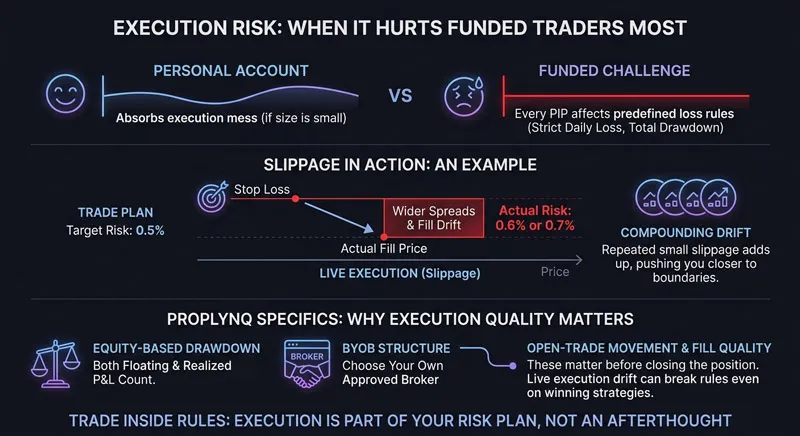
For example, a stop intended to risk 0.5% can become 0.6% or 0.7% once spreads widen and the fill slips through the level. That may not sound dramatic, but repeated execution drift adds up. Traders often blame strategy failure when the real issue is that their live fills are worse than their backtest assumptions.
If you trade inside prop rules, execution quality should be part of your risk plan, not an afterthought. That is especially true if you are already managing tight loss limits, which is why it helps to understand how drawdown structures change trading pressure and to review how disciplined challenge execution works in practice.
PropLynq’s public materials make this especially relevant because the firm states that challenge drawdown is equity-based, both floating and realized P&L count, and approved-broker trading happens under a BYOB structure. In plain terms, open-trade movement and fill quality can matter before you ever close the position. If you are comparing firms or models, review the live trading account structures and the funded-trader process before assuming your strategy will behave the same way under evaluation rules.
How to protect your fills without overcomplicating your trading
If you are asking what is slippage in forex because you want to avoid it completely, the honest answer is that you usually cannot remove it entirely. You can only reduce it, plan for it, and stop pretending your fills will always be perfect.
- Trade more liquid pairs when possible, especially if you are still building consistency.
- Avoid impulsive market orders during major data releases unless news execution is part of your actual edge.
- Use limit orders when price precision matters more than guaranteed entry.
- Reduce position size in fast conditions so a bad fill does not distort your risk plan.
- Check your broker connection, VPS setup, and execution history instead of blaming every bad fill on the market.
- Track live slippage in your journal. If your backtest assumes perfect fills, your numbers are incomplete.
The goal is not to trade scared. The goal is to stop sizing and planning as if friction does not exist. Traders who ignore execution costs often think they need a better strategy when they really need better assumptions. That is the practical side of what is slippage in forex: execution reality has to be part of your model, not an excuse you invent after the trade.
What traders misunderstand about slippage in forex
One reason what is slippage in forex gets misunderstood is that traders usually notice only the painful side of it. A few common mistakes keep the confusion alive.
Mistake one: assuming slippage is always negative. It is not. Positive slippage exists too, even if traders remember the bad fills more clearly. When traders search what is slippage in forex, they usually mean the painful version, but the definition includes favorable fills as well.
Mistake two: confusing slippage with spread. Spread is the bid-ask difference before execution. Slippage is the difference between expected and actual execution price.
Mistake three: blaming every slippage event on broker abuse. Bad execution can come from poor infrastructure, but it can also come from normal market behavior during fast or thin conditions.
Mistake four: using very tight stops on volatile pairs and acting surprised when live fills look worse than simulation. Tight planning and real-world execution are not always compatible.
Mistake five: treating requotes as the same thing. They are cousins, not twins. Slippage changes the fill. A requote changes the quote.
Final takeaway: execution is part of risk
So, what is slippage in forex? It is the difference between the price you expected and the price you actually receive when the market executes your order. It can be positive or negative, but it always reflects one reality: trading happens in a moving market, not on a frozen screenshot.
The difference between slippage and a requote is just as important. Slippage means the trade fills at a changed price. A requote means the original price is unavailable and you are offered a new one. Once you understand that difference, execution behavior becomes easier to diagnose.
For most traders, the practical lesson is simple. Choose liquid conditions, plan around volatility, and size your trades as if fills will sometimes be imperfect. If you trade under challenge rules or funded-account limits, build that assumption into your process from day one. That is where what is slippage in forex stops being a glossary term and starts becoming a real risk-management skill.
Leave a Reply